SKU stands for Stock Keeping Unit.

SKU Numbers in eCommerce: Meaning, Examples & How to Use Them
Selling 50+ products but still tracking your inventory manually in a notebook? You need SKUs!
SKU numbers are everywhere in ecommerce, on packaging, on invoices, inside every inventory system, but most new sellers never quite understood what they are or why they matter. The result is usually a spreadsheet full of product names like "Blue Shirt," "Blue Shirt 2," and "Blue Shirt New" with no real way to tell them apart once stock starts piling up.
Here's everything you need to know about SKU in ecommerce, with a simple way to create your own system.
SKU numbers are everywhere in ecommerce, on packaging, on invoices, inside every inventory system, but most new sellers never quite understood what they are or why they matter. The result is usually a spreadsheet full of product names like "Blue Shirt," "Blue Shirt 2," and "Blue Shirt New" with no real way to tell them apart once stock starts piling up.
Here's everything you need to know about SKU in ecommerce, with a simple way to create your own system.
What is an SKU Number?
A SKU (Stock Keeping Unit) is a unique code assigned to every product or product variation to help businesses track inventory, manage stock, and process orders efficiently.
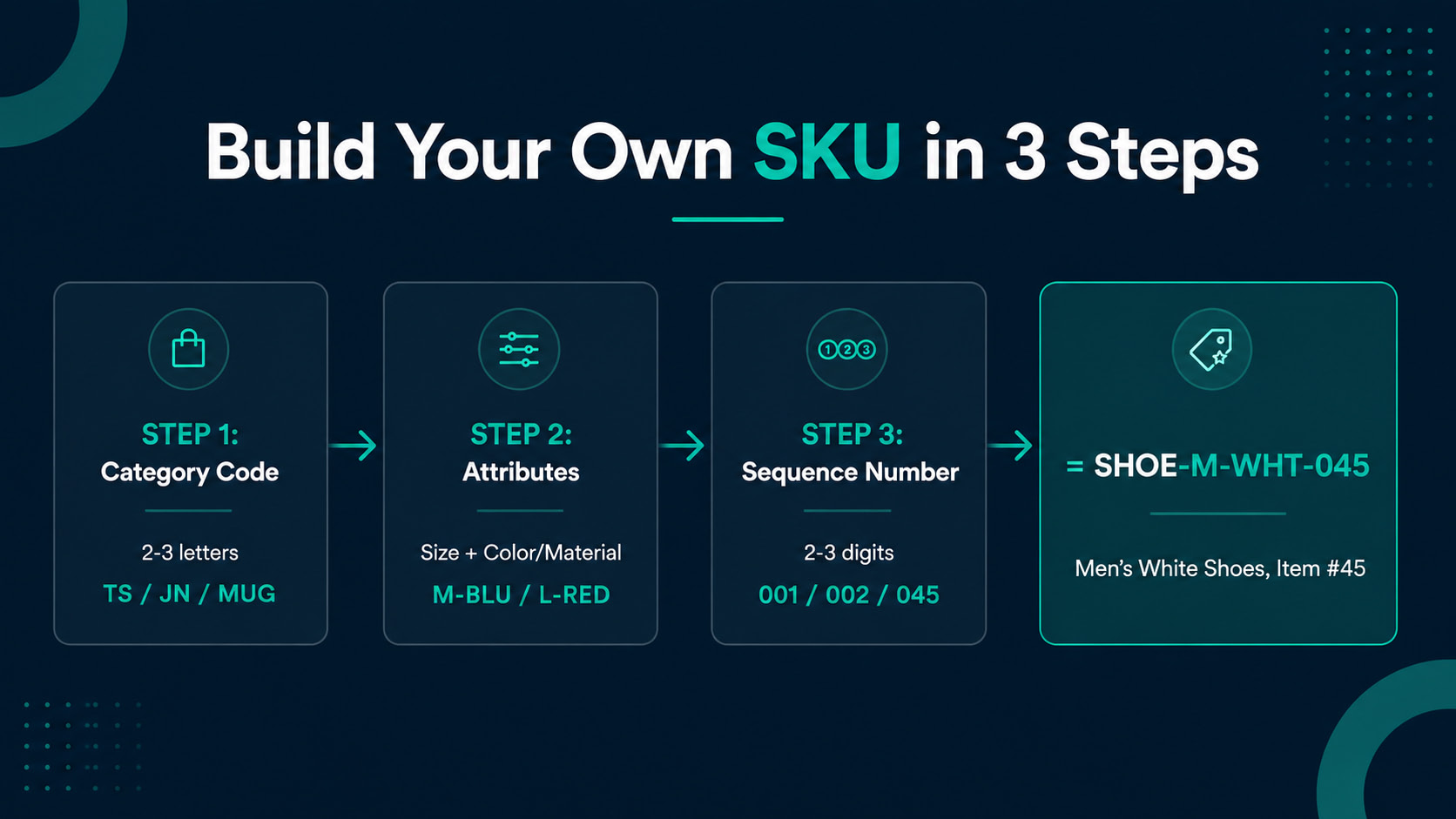
Unlike barcodes or UPCs, SKU numbers are created by the seller and can be customized based on product attributes such as size, color, or material.
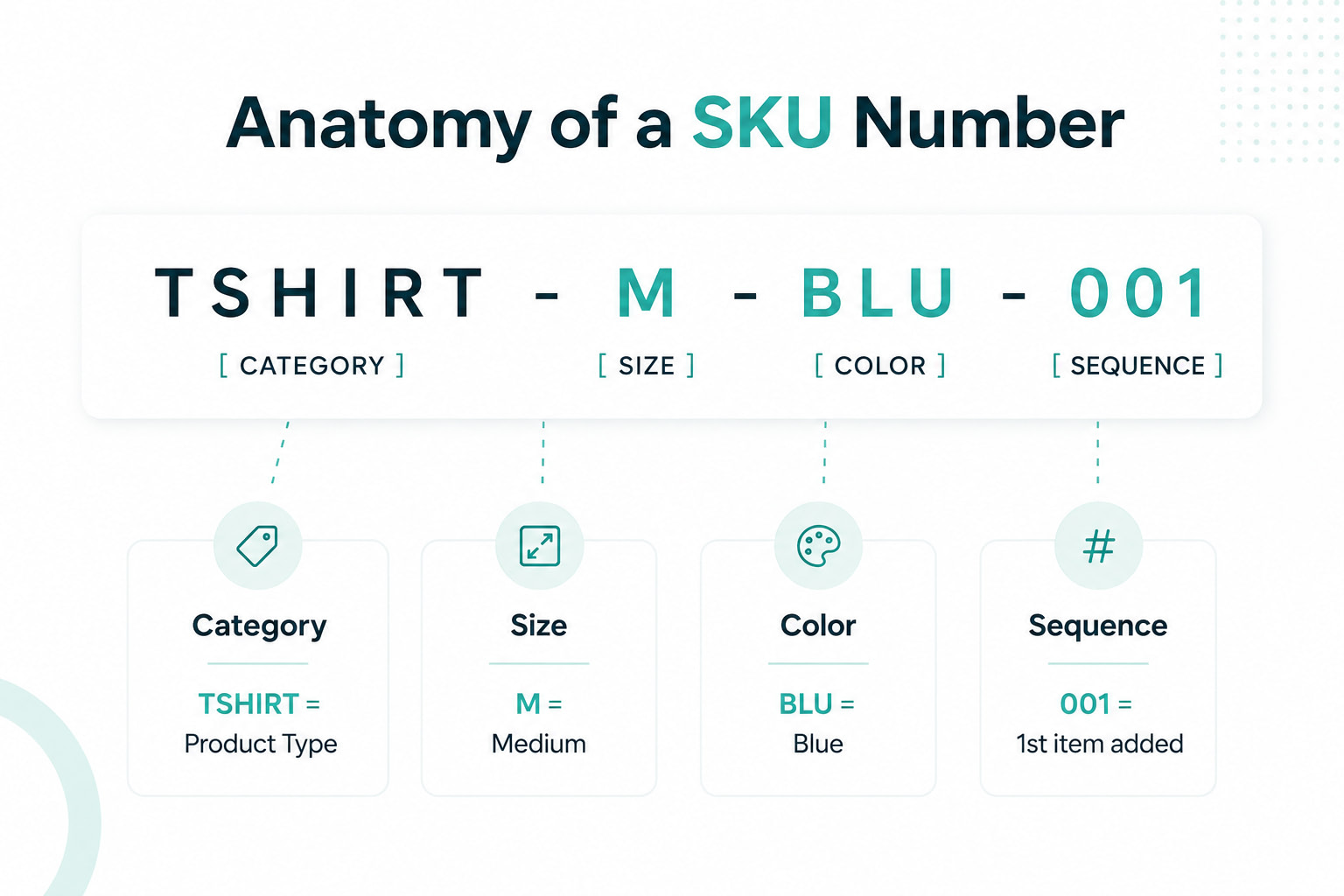
A typical SKU number example looks like this: TSHIRT-M-BLU-001.
To break it down into simpler terms, TSHIRT tells you the product type, M is the size (Medium), BLU is the color (Blue), and 001 is the sequence number for that specific item.
Most SKUs run 8-12 characters combining letters and numbers.They are short enough to scan quickly but descriptive enough to contain meaningful information about the product.
Unlike barcodes or UPCs, SKU numbers are created by the seller and can be customized based on product attributes such as size, color, or material.
A typical SKU number example looks like this: TSHIRT-M-BLU-001.
To break it down into simpler terms, TSHIRT tells you the product type, M is the size (Medium), BLU is the color (Blue), and 001 is the sequence number for that specific item.
Most SKUs run 8-12 characters combining letters and numbers.They are short enough to scan quickly but descriptive enough to contain meaningful information about the product.
The key is consistency. Once you choose a SKU format, use the same structure across every product and product variation to make searching, reporting, and inventory management much easier.
Where to Find SKU Numbers
Wondering where to find the SKU code on a product or in your systems? Here are the five most common places:
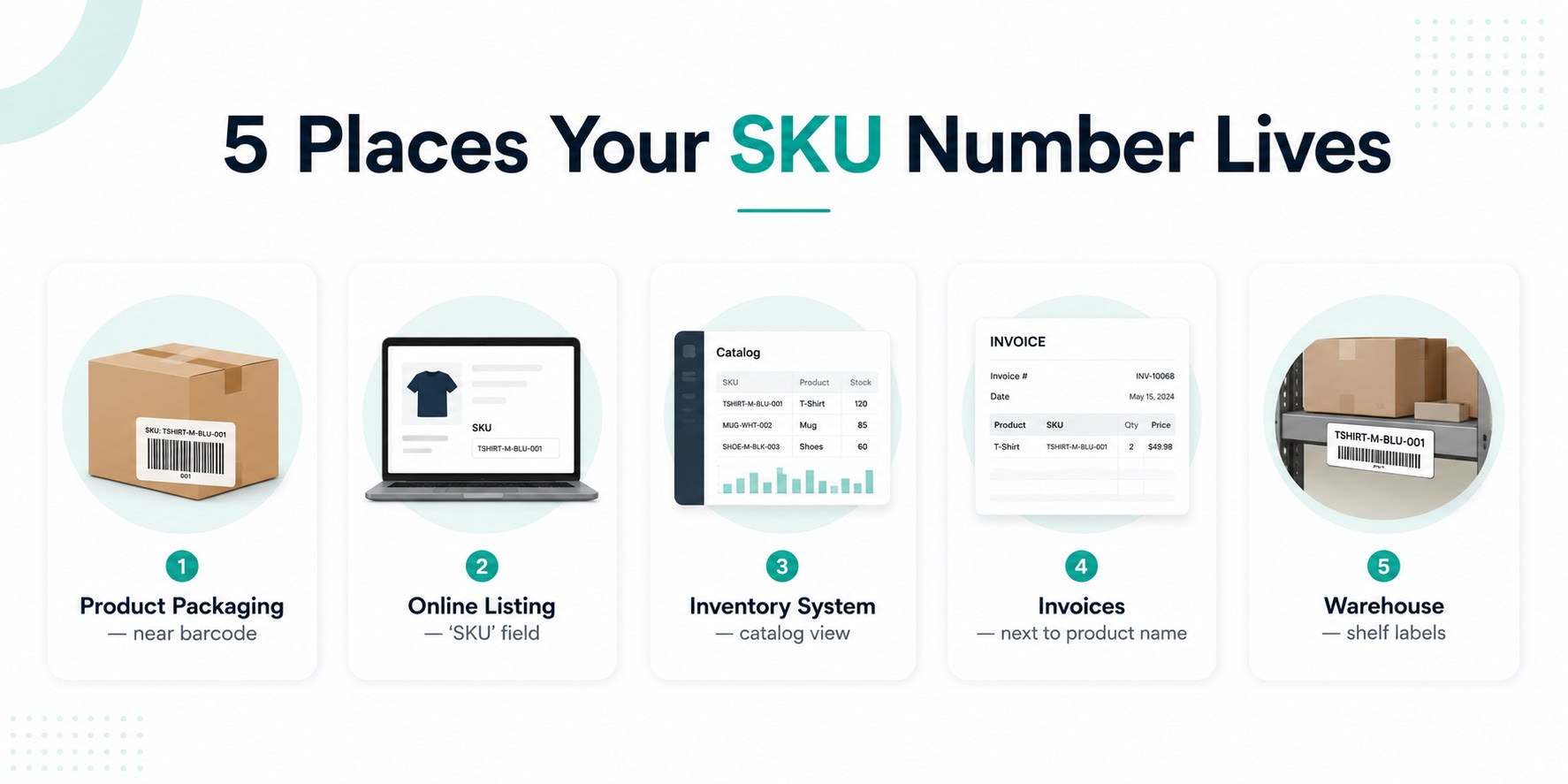
• On product packaging: Manufacturers or sellers typically print the SKU near the barcode or product label. Warehouse teams use this code to receive, store, and dispatch inventory accurately.
• In the online store listing: Look for a "SKU" or "Item number" field in the product description section of any product page. Most ecommerce platforms display this field clearly so customers and sellers can reference the exact variant being purchased.
• In your inventory system: Amazon Smart Commerce displays SKUs directly within the product catalog and order details. Every incoming order is linked to a specific SKU, making it easy to track which product needs to be picked, packed, and shipped.
• On receipts and invoices: SKUs appear alongside the product name on purchase receipts, seller invoices, and return documents. This makes it straightforward to identify the exact product and variant involved in any transaction, especially useful when processing returns or exchanges.
• In the warehouse: Shelf labels and bin location tags often include the SKU alongside the product name. Staff use these codes to find, pick, and pack the right product quickly, especially when multiple similar variants are stored close together.
• On product packaging: Manufacturers or sellers typically print the SKU near the barcode or product label. Warehouse teams use this code to receive, store, and dispatch inventory accurately.
• In the online store listing: Look for a "SKU" or "Item number" field in the product description section of any product page. Most ecommerce platforms display this field clearly so customers and sellers can reference the exact variant being purchased.
• In your inventory system: Amazon Smart Commerce displays SKUs directly within the product catalog and order details. Every incoming order is linked to a specific SKU, making it easy to track which product needs to be picked, packed, and shipped.
• On receipts and invoices: SKUs appear alongside the product name on purchase receipts, seller invoices, and return documents. This makes it straightforward to identify the exact product and variant involved in any transaction, especially useful when processing returns or exchanges.
• In the warehouse: Shelf labels and bin location tags often include the SKU alongside the product name. Staff use these codes to find, pick, and pack the right product quickly, especially when multiple similar variants are stored close together.
Once you know what to look for, how to find a SKU becomes second nature, it's usually sitting right next to the product name wherever you're looking.
Why SKU Numbers Matter for Ecommerce
Beyond just naming products, a solid SKU in an ecommerce strategy solves real operational problems. Here's what that looks like in practice:
Accurate inventory tracking: Instead of guessing stock levels from memory or rough estimates, you know exactly how many units of each product variant you have and where they're stored. Picture a seller with 30 t-shirt variants across three colors and five sizes. Without SKUs, a quick restock check means physically counting every shelf. With SKUs, the inventory dashboard shows each variant's stock count in seconds.
Faster order fulfillment: Warehouse staff locate exact items using SKUs instead of trying to interpret vague descriptions under time pressure. Consider a customer who orders a medium blue kurta. Without a SKU, a picker searches through a rack of similar items trying to identify the right color and size. With the SKU KURTA-M-BLU-023 on the shelf label, they walk directly to the right spot, pick it in seconds, and move on.
Sales analysis at a granular level: With proper inventory SKU system tracking, you can see exactly which colors, sizes, or variants sell fastest and which sit unsold month after month. A home decor seller might discover that their brass diyas in small size sell 4x faster than large ones. That insight directly informs the next restock order, preventing both stockouts and dead inventory.
Multichannel selling stays synced: When you use the same SKU across your own website and other online marketplaces, one product maps to one code everywhere. Without this, a seller who gets 10 orders across three platforms might accidentally oversell a product that only had 6 units in stock, because each platform was tracking inventory separately with no shared reference point.
Accurate inventory tracking: Instead of guessing stock levels from memory or rough estimates, you know exactly how many units of each product variant you have and where they're stored. Picture a seller with 30 t-shirt variants across three colors and five sizes. Without SKUs, a quick restock check means physically counting every shelf. With SKUs, the inventory dashboard shows each variant's stock count in seconds.
Faster order fulfillment: Warehouse staff locate exact items using SKUs instead of trying to interpret vague descriptions under time pressure. Consider a customer who orders a medium blue kurta. Without a SKU, a picker searches through a rack of similar items trying to identify the right color and size. With the SKU KURTA-M-BLU-023 on the shelf label, they walk directly to the right spot, pick it in seconds, and move on.
Sales analysis at a granular level: With proper inventory SKU system tracking, you can see exactly which colors, sizes, or variants sell fastest and which sit unsold month after month. A home decor seller might discover that their brass diyas in small size sell 4x faster than large ones. That insight directly informs the next restock order, preventing both stockouts and dead inventory.
Multichannel selling stays synced: When you use the same SKU across your own website and other online marketplaces, one product maps to one code everywhere. Without this, a seller who gets 10 orders across three platforms might accidentally oversell a product that only had 6 units in stock, because each platform was tracking inventory separately with no shared reference point.
Best Practices we recommend for SKU Management
A few simple habits keep your SKU system useful as your catalog grows:
• Keep it simple. Short, readable codes work better than long strings of random characters that nobody can interpret quickly. If your team can't read a SKU and understand the product, the system isn't working.
• Be consistent. Use the same format and character order across every single product, no exceptions. Inconsistency is where SKU systems break down, especially when different team members create codes in different ways.
• Avoid special characters. Stick to letters and numbers; hyphens are fine, but symbols like # or % can cause issues in spreadsheets and systems. Special characters often break imports, exports, and integrations between platforms.
• Don't rely on manufacturer codes. Build your own system, so you have full control over what each part of the code means. Manufacturer codes are designed for their internal use and rarely reflect the attributes that matter most to your operations.
• Never reuse SKUs. Once a SKU has been assigned to a product, never reassign that same code to a different product even after the original is discontinued. Reusing codes creates confusion in historical data, past orders, and reports that reference the old product.
• Review your SKU structure regularly. As your catalog grows or your product range expands into new categories, your original SKU format may need updating. A quarterly review ensures your system still makes sense for your current catalog and doesn't create inconsistencies as new product lines are added.
• Use inventory software once you scale. Manual SKU tracking holds up fine for a handful of products, but it breaks down fast past 50 products. Amazon Smart Commerce automates SKU creation and tracking, so this never becomes a bottleneck.
• Keep it simple. Short, readable codes work better than long strings of random characters that nobody can interpret quickly. If your team can't read a SKU and understand the product, the system isn't working.
• Be consistent. Use the same format and character order across every single product, no exceptions. Inconsistency is where SKU systems break down, especially when different team members create codes in different ways.
• Avoid special characters. Stick to letters and numbers; hyphens are fine, but symbols like # or % can cause issues in spreadsheets and systems. Special characters often break imports, exports, and integrations between platforms.
• Don't rely on manufacturer codes. Build your own system, so you have full control over what each part of the code means. Manufacturer codes are designed for their internal use and rarely reflect the attributes that matter most to your operations.
• Never reuse SKUs. Once a SKU has been assigned to a product, never reassign that same code to a different product even after the original is discontinued. Reusing codes creates confusion in historical data, past orders, and reports that reference the old product.
• Review your SKU structure regularly. As your catalog grows or your product range expands into new categories, your original SKU format may need updating. A quarterly review ensures your system still makes sense for your current catalog and doesn't create inconsistencies as new product lines are added.
• Use inventory software once you scale. Manual SKU tracking holds up fine for a handful of products, but it breaks down fast past 50 products. Amazon Smart Commerce automates SKU creation and tracking, so this never becomes a bottleneck.
Move from Inventory Chaos to Control
Whether you sell 20 products or 2,000, a well-designed SKU system helps you stay organized, reduce inventory errors, and scale your ecommerce business with confidence. Starting with a simple, consistent structure today can save countless hours of manual work as your business grows.
Start simple, stay consistent, and lean on tools that handle the tracking automatically once your catalog grows.
Amazon Smart Commerce manages SKUs, inventory, and tracking without the manual work, so your catalog stays organized no matter how fast it scales.
Start simple, stay consistent, and lean on tools that handle the tracking automatically once your catalog grows.
Amazon Smart Commerce manages SKUs, inventory, and tracking without the manual work, so your catalog stays organized no matter how fast it scales.
How These Widgets Work Together to Build a Branded Storefront
How These Widgets Work Together to Build a Branded Storefront
The real power isn't in any one widget-it's in how they work together to transform a static product catalog into a branded customer journey.
Imagine a customer landing on your homepage.
They first see a Row Grid section introducing your latest campaign with rich visuals and featured collections.
A Text Block immediately follows, telling the story behind the collection or your brand philosophy.
An Image Showcase then places your products into real-life contexts that create aspiration.
Further down, a Lookbook encourages discovery by letting customers shop complete looks instead of individual products.
Finally, Collapsible Content answers shipping, sizing, and policy questions without disrupting the browsing experience.
This isn't simply a better-looking storefront-it's a better shopping experience from the first click to the final purchase.
Customers stay longer, explore more pages, and interact with products differently when a storefront feels like a thoughtfully designed brand instead of a digital product catalog.
Smart Commerce by Amazon now gives independent sellers access to design capabilities that were previously available only through custom-built websites or enterprise ecommerce platforms, helping close the gap between emerging brands and established retailers.
The real power isn't in any one widget-it's in how they work together to transform a static product catalog into a branded customer journey.
Imagine a customer landing on your homepage.
They first see a Row Grid section introducing your latest campaign with rich visuals and featured collections.
A Text Block immediately follows, telling the story behind the collection or your brand philosophy.
An Image Showcase then places your products into real-life contexts that create aspiration.
Further down, a Lookbook encourages discovery by letting customers shop complete looks instead of individual products.
Finally, Collapsible Content answers shipping, sizing, and policy questions without disrupting the browsing experience.
This isn't simply a better-looking storefront-it's a better shopping experience from the first click to the final purchase.
Customers stay longer, explore more pages, and interact with products differently when a storefront feels like a thoughtfully designed brand instead of a digital product catalog.
Smart Commerce by Amazon now gives independent sellers access to design capabilities that were previously available only through custom-built websites or enterprise ecommerce platforms, helping close the gap between emerging brands and established retailers.
Frequently Asked Questions
1. What does SKU stand for?
2. Where can I find a SKU number?
SKU numbers are usually found on product packaging, invoices, inventory software, warehouse labels, and online product listings.
3. Is a SKU the same as a barcode?
No.
A SKU is created by the seller, while a barcode represents a machine-readable code used for scanning products.
A SKU is created by the seller, while a barcode represents a machine-readable code used for scanning products.
4. Can I create my own SKU numbers?
Yes.
Businesses create their own SKU numbering systems based on categories, colors, sizes, or other attributes.
Businesses create their own SKU numbering systems based on categories, colors, sizes, or other attributes.
5. How long should a SKU be?
Most SKU numbers are between 8–12 characters, although the ideal length depends on your catalog size and product complexity.


COMPANY


Built in

© 2026 Amazon.com, Inc. or its affiliates. All rights reserved