
Hard Work vs Smart Work: Why Online Sellers Struggle Without Strategy
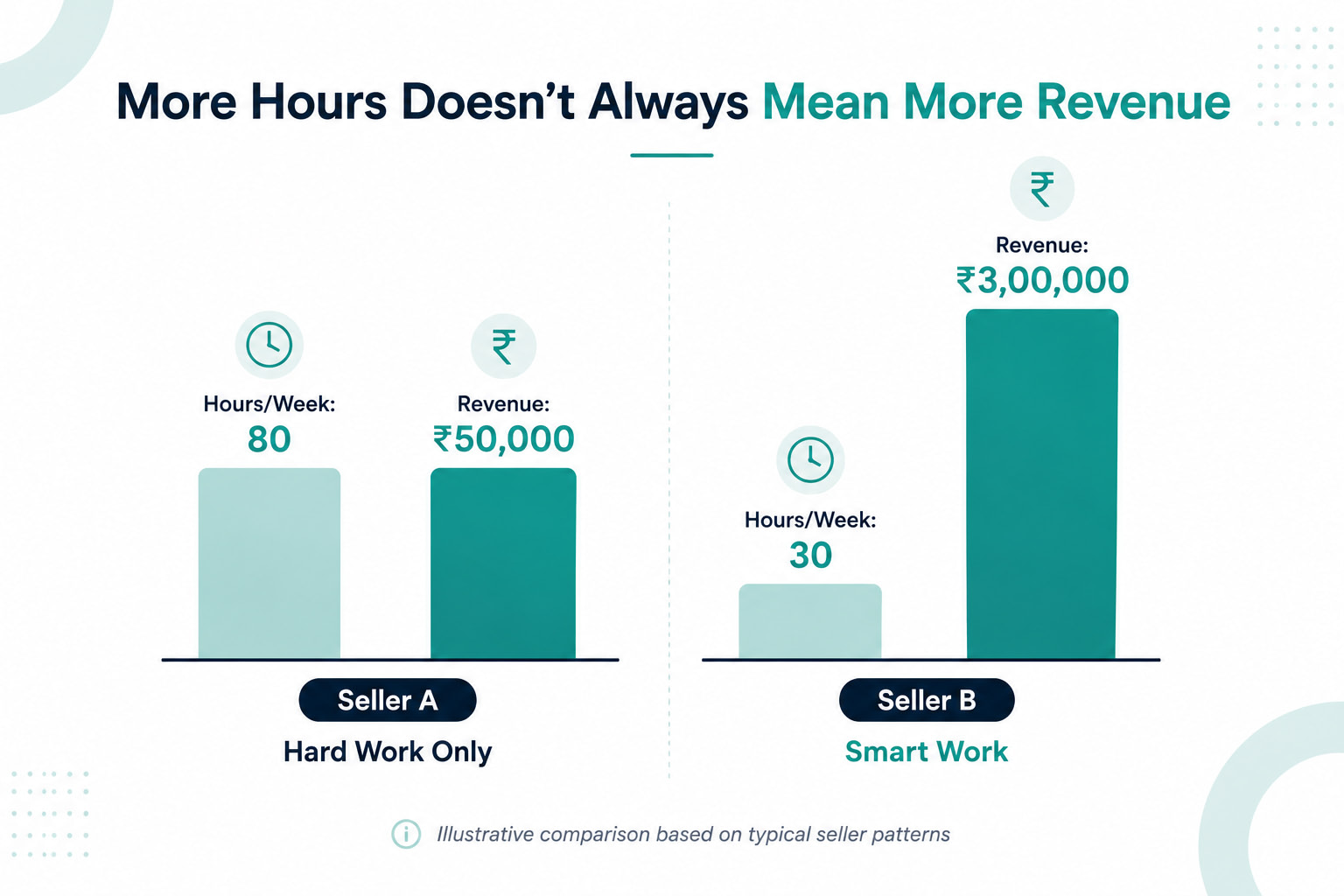
Working 80 hours a week but still making only ₹50,000 a month? You're not failing because you're not trying , you're failing because effort alone was never the real bottleneck.
The biggest challenge for many founders isn't finding more time - it's building an ecommerce business that can grow without depending entirely on their personal effort.
This is the difference between hard work and smart work, and understanding it changes how you think about how to grow an e-commerce business for the long term.
The biggest challenge for many founders isn't finding more time - it's building an ecommerce business that can grow without depending entirely on their personal effort.
This is the difference between hard work and smart work, and understanding it changes how you think about how to grow an e-commerce business for the long term.
Why Systems Scale an Ecommerce Business
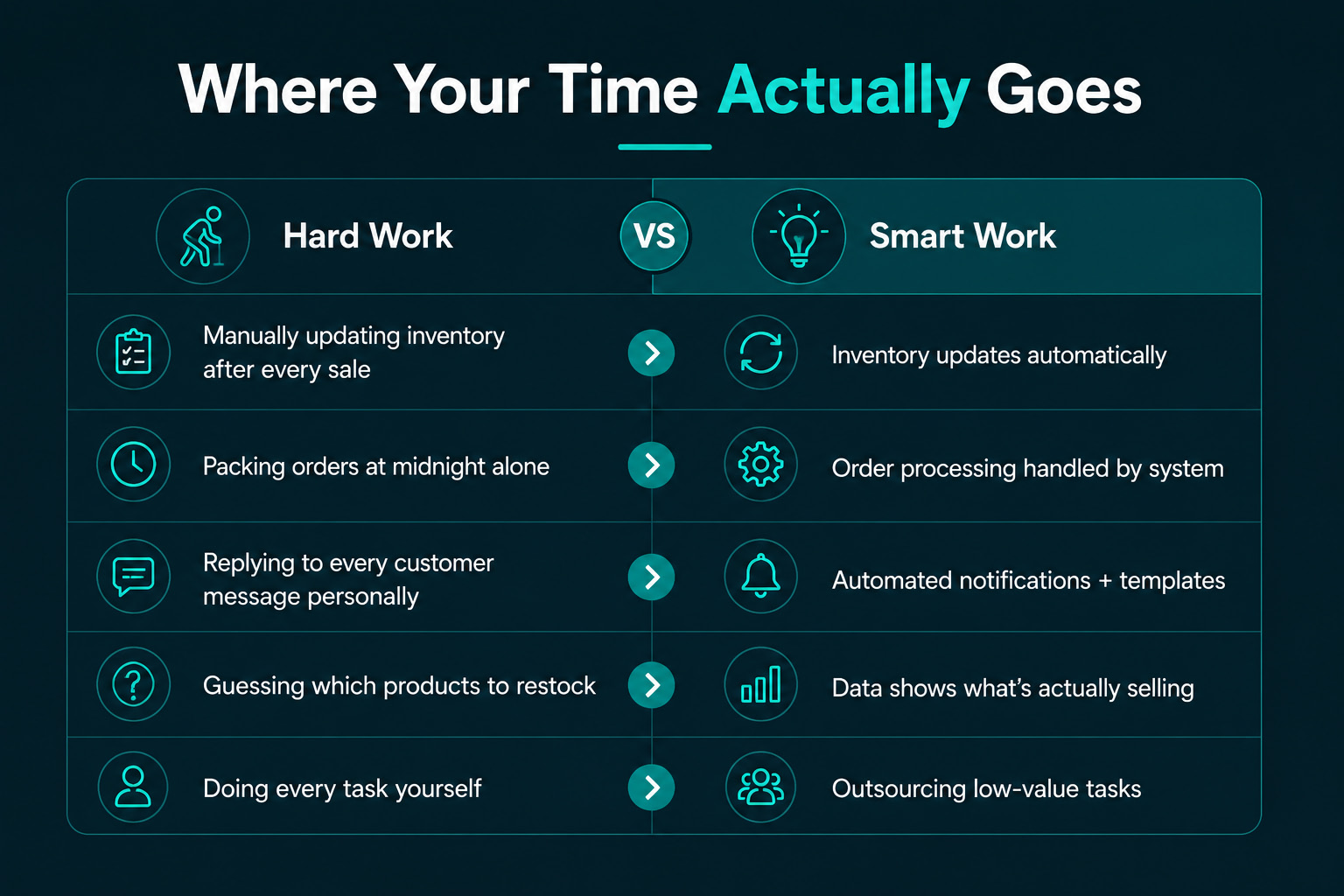
Hard work in e-commerce looks like packing orders at midnight, manually updating inventory spreadsheets after every sale, and personally replying to every single customer message, no matter the time of day. It's necessary in the early days, and it builds a genuine understanding of your business. But it doesn't scale.
Smart work means using systems, automation, and tools to handle the repetitive parts of running a business, so your time goes toward decisions that actually move the needle. Instead of manually processing every order, a system does it. Instead of guessing what to restock, data tells you. Smart work isn't about doing less; it's about making sure your effort goes toward things only you can do.
As an ecommerce business grows, systems become more valuable than additional working hours because they allow operations to expand without increasing the founder's workload.
This distinction matters because most sellers never consciously choose one or the other. They just default to hard work because it feels productive, even when it isn't driving e-commerce business growth.
Smart work means using systems, automation, and tools to handle the repetitive parts of running a business, so your time goes toward decisions that actually move the needle. Instead of manually processing every order, a system does it. Instead of guessing what to restock, data tells you. Smart work isn't about doing less; it's about making sure your effort goes toward things only you can do.
As an ecommerce business grows, systems become more valuable than additional working hours because they allow operations to expand without increasing the founder's workload.
This distinction matters because most sellers never consciously choose one or the other. They just default to hard work because it feels productive, even when it isn't driving e-commerce business growth.
Why Hard Work Alone Can't Scale an E-Commerce Business
Here's the trap. There are only 24 hours in a day, and your revenue can't keep growing forever if it's directly tied to your personal time. At some point, working more hours simply isn't possible, and that's exactly where many sellers hit a wall they don't understand.
Every growing online business eventually reaches a point where operational complexity becomes a bigger challenge than customer acquisition.
Consider two sellers running similar businesses. One works roughly 70 hours a week, doing everything manually, and makes around ₹1 lakh a month. The other works 30 hours a week and makes ₹3 lakhs a month.
That's the difference between running your business and designing systems that allow it to grow. The second seller automated order processing, used data to decide what to stock, and stopped spending hours on tasks that tools could handle instead.
Every growing online business eventually reaches a point where operational complexity becomes a bigger challenge than customer acquisition.
Consider two sellers running similar businesses. One works roughly 70 hours a week, doing everything manually, and makes around ₹1 lakh a month. The other works 30 hours a week and makes ₹3 lakhs a month.
That's the difference between running your business and designing systems that allow it to grow. The second seller automated order processing, used data to decide what to stock, and stopped spending hours on tasks that tools could handle instead.
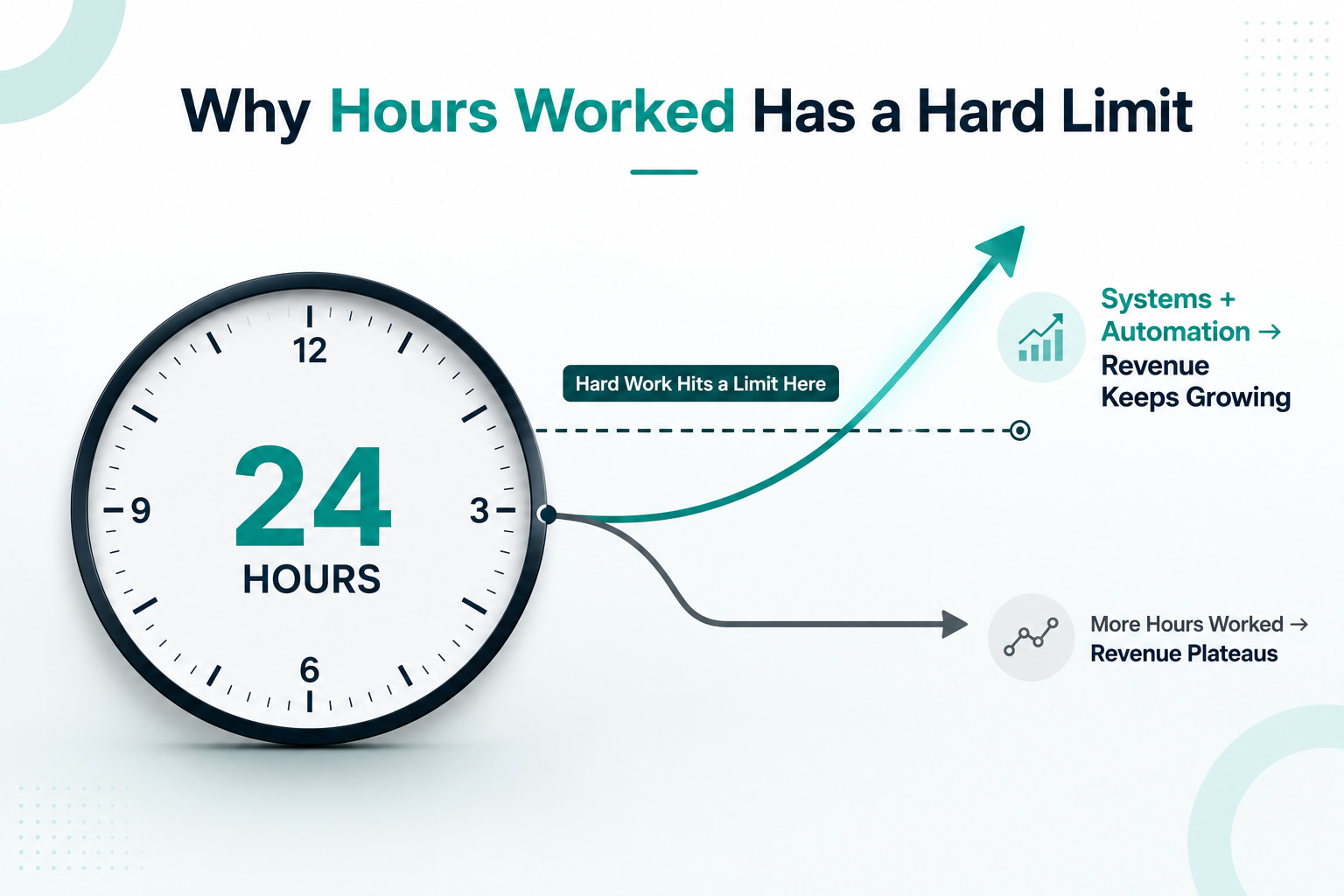
This is the burnout cycle in action: more hours, more exhaustion, more mistakes, and eventually, a ceiling that no amount of additional effort can break through. E-commerce business growth beyond a certain point requires stepping back from the grind, not leaning further into it.
Smart Work Strategies That Help Online Sellers Scale
Smart work isn't a vague mindset shift, it's a set of practical changes most sellers can make right away.
• Automate repetitive operational tasks: Order processing, inventory updates, and customer notifications can all run without manual input. Amazon Smart Commerce handles these automatically, freeing up hours every week that used to go into busywork.
• Make data-driven inventory and sales decisions: Stop guessing what sells. Use analytics to see exactly which products perform and double down on those, while cutting the ones that quietly drain time and inventory space without delivering returns.
• Batch similar tasks together: Dedicate a day to photography, a day to listing new products, a day to marketing, instead of switching between unrelated tasks every hour. Context-switching is one of the most underrated productivity killers in small businesses.
• Outsource low-value work: Packaging, basic customer service replies, and routine image editing can all be handed off. If your time is worth more than ₹200 an hour doing strategic work, spending it on tasks that cost less than that to outsource is a losing trade.
These ecommerce automation tools and habits don't just save time; they directly translate into how to increase online sales because your energy shifts toward growth instead of maintenance.
• Automate repetitive operational tasks: Order processing, inventory updates, and customer notifications can all run without manual input. Amazon Smart Commerce handles these automatically, freeing up hours every week that used to go into busywork.
• Make data-driven inventory and sales decisions: Stop guessing what sells. Use analytics to see exactly which products perform and double down on those, while cutting the ones that quietly drain time and inventory space without delivering returns.
• Batch similar tasks together: Dedicate a day to photography, a day to listing new products, a day to marketing, instead of switching between unrelated tasks every hour. Context-switching is one of the most underrated productivity killers in small businesses.
• Outsource low-value work: Packaging, basic customer service replies, and routine image editing can all be handed off. If your time is worth more than ₹200 an hour doing strategic work, spending it on tasks that cost less than that to outsource is a losing trade.
These ecommerce automation tools and habits don't just save time; they directly translate into how to increase online sales because your energy shifts toward growth instead of maintenance.
How the 80/20 Rule Helps Ecommerce Businesses Grow
One of the most useful realizations (also known as the Pareto Principle) for any seller is this: roughly 20% of your products generate 80% of your revenue, and roughly 20% of your daily activities drive 80% of your results.
Most sellers treat every product in their catalog equally, spending the same energy on a SKU that sells once a month as one that sells fifty times. That's a mistake. Pull up your sales data and identify your top 15-20 performing products. These are the ones worth your attention; better photography, better descriptions, and more marketing push. The rest of your catalog can run on autopilot or get phased out entirely.
Scaling an ecommerce business isn't about doing more tasks—it's about focusing on the few activities that create disproportionate results.
Most sellers treat every product in their catalog equally, spending the same energy on a SKU that sells once a month as one that sells fifty times. That's a mistake. Pull up your sales data and identify your top 15-20 performing products. These are the ones worth your attention; better photography, better descriptions, and more marketing push. The rest of your catalog can run on autopilot or get phased out entirely.
Scaling an ecommerce business isn't about doing more tasks—it's about focusing on the few activities that create disproportionate results.
How Amazon Smart Commerce Enables Smart Work
The businesses that scale aren't necessarily the ones with the biggest teams or the longest working hours, they're the ones that build systems capable of handling growth. As your order volume increases, relying on manual processes becomes a bottleneck, making automation and visibility essential for sustainable growth.
Amazon Smart Commerce brings these capabilities together in one platform, helping sellers automate order management, inventory tracking, customer segmentation, and performance analytics. Instead of juggling multiple tools or spending hours on repetitive operational tasks, sellers can manage their business from a single dashboard.
Built with a mobile-first approach, Amazon Smart Commerce lets you manage your ecommerce operations on the go. From built-in SEO and payment integrations to logistics support and inventory management, the platform removes much of the complexity involved in running and scaling an online business. Whether you're selling through your own website or expanding into multichannel and omnichannel commerce, everything stays connected and organized without constant manual effort.
That's what smart work looks like in practice – not replacing effort, but directing it toward decisions that drive growth while the repetitive work happens in the background.
Amazon Smart Commerce brings these capabilities together in one platform, helping sellers automate order management, inventory tracking, customer segmentation, and performance analytics. Instead of juggling multiple tools or spending hours on repetitive operational tasks, sellers can manage their business from a single dashboard.
Built with a mobile-first approach, Amazon Smart Commerce lets you manage your ecommerce operations on the go. From built-in SEO and payment integrations to logistics support and inventory management, the platform removes much of the complexity involved in running and scaling an online business. Whether you're selling through your own website or expanding into multichannel and omnichannel commerce, everything stays connected and organized without constant manual effort.
That's what smart work looks like in practice – not replacing effort, but directing it toward decisions that drive growth while the repetitive work happens in the background.
Work Smarter, Not Just Harder
Hard work will always be part of building a successful business. In the early stages, putting in extra hours is often unavoidable. But long-term ecommerce growth doesn't come from working longer, it comes from building systems that allow your business to grow beyond your own time and capacity.
The sellers scaling to ₹1 crore and beyond aren't simply working harder than everyone else. They're making better use of their time by automating routine tasks, using data to make smarter decisions, and focusing their energy on strategy instead of day-to-day operations.
If there's one takeaway, it's this: every hour you save on repetitive work is an hour you can invest in growing your business.
Amazon Smart Commerce helps make that shift possible with built-in automation, inventory management, analytics, and customer insights designed to help sellers scale with confidence.
The sellers scaling to ₹1 crore and beyond aren't simply working harder than everyone else. They're making better use of their time by automating routine tasks, using data to make smarter decisions, and focusing their energy on strategy instead of day-to-day operations.
If there's one takeaway, it's this: every hour you save on repetitive work is an hour you can invest in growing your business.
Amazon Smart Commerce helps make that shift possible with built-in automation, inventory management, analytics, and customer insights designed to help sellers scale with confidence.


COMPANY


Built in

© 2026 Amazon.com, Inc. or its affiliates. All rights reserved