
Why July Is the Best Time to Start Planning for the Festive Season
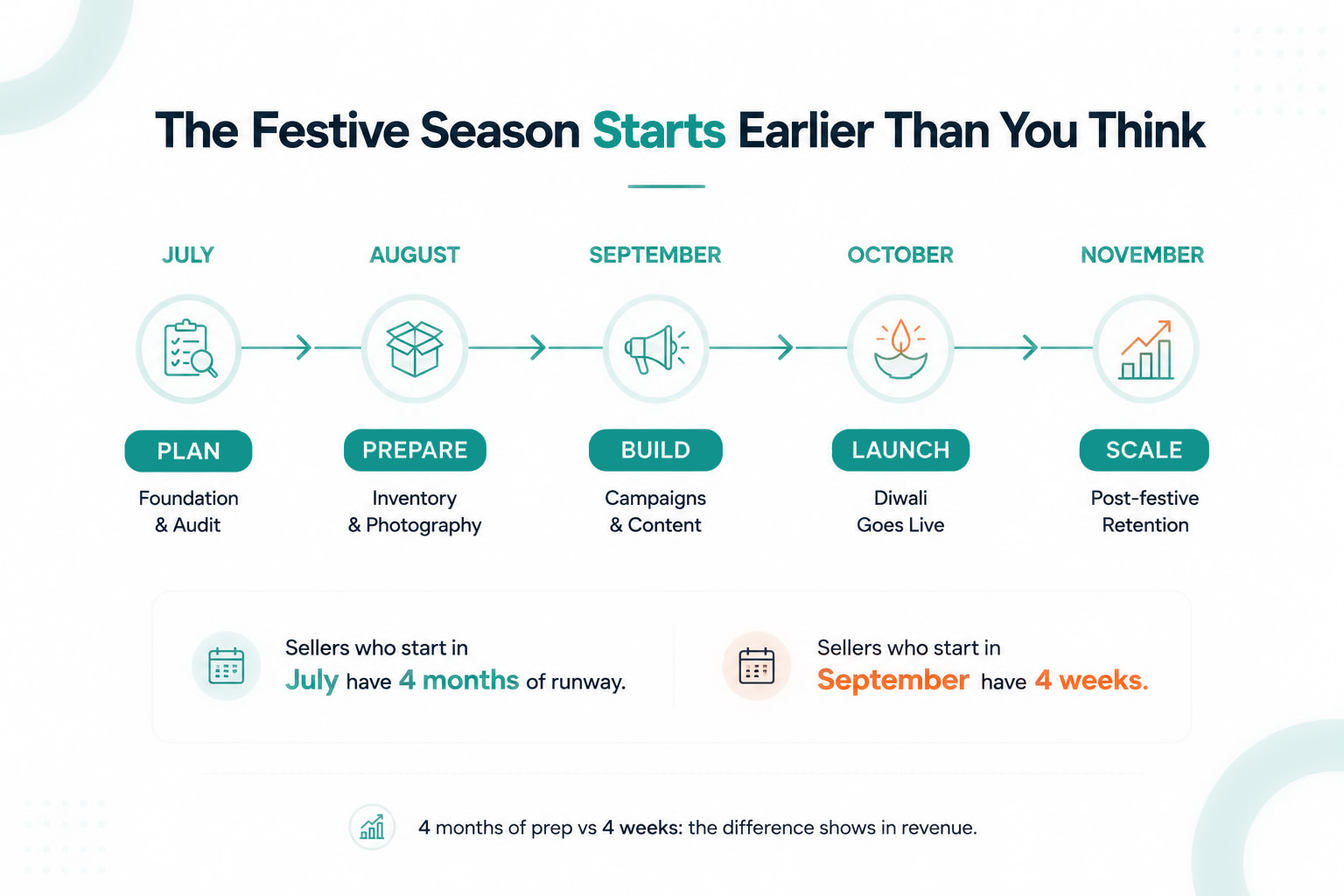
Ask any founder what they wish they'd done differently after the festive season, and you'll hear the same answer: started earlier. While most sellers wait until September to scramble for inventory and book photographers for the festive season, successful campaigns are actually planned 60 to 90 days in advance. When you factor in product sourcing, logistics, and creative asset production, July isn’t early, it’s exactly on time.
India's festive quarter, spanning Navratri, Dhanteras, Diwali, and Bhai Dooj, accounts for a significant share of annual D2C revenue. The brands that dominate this period don’t figure out their strategy mid-campaign; they build their operational and marketing foundations months in advance. By starting your prep in July, you ensure that when the high-volume traffic hits, your store runs smoothly, predictably, and profitably.
Here are the eight areas to get right before August even begins.
India's festive quarter, spanning Navratri, Dhanteras, Diwali, and Bhai Dooj, accounts for a significant share of annual D2C revenue. The brands that dominate this period don’t figure out their strategy mid-campaign; they build their operational and marketing foundations months in advance. By starting your prep in July, you ensure that when the high-volume traffic hits, your store runs smoothly, predictably, and profitably.
Here are the eight areas to get right before August even begins.
1. Website Audit: Is Your Store Ready for Peak Traffic?
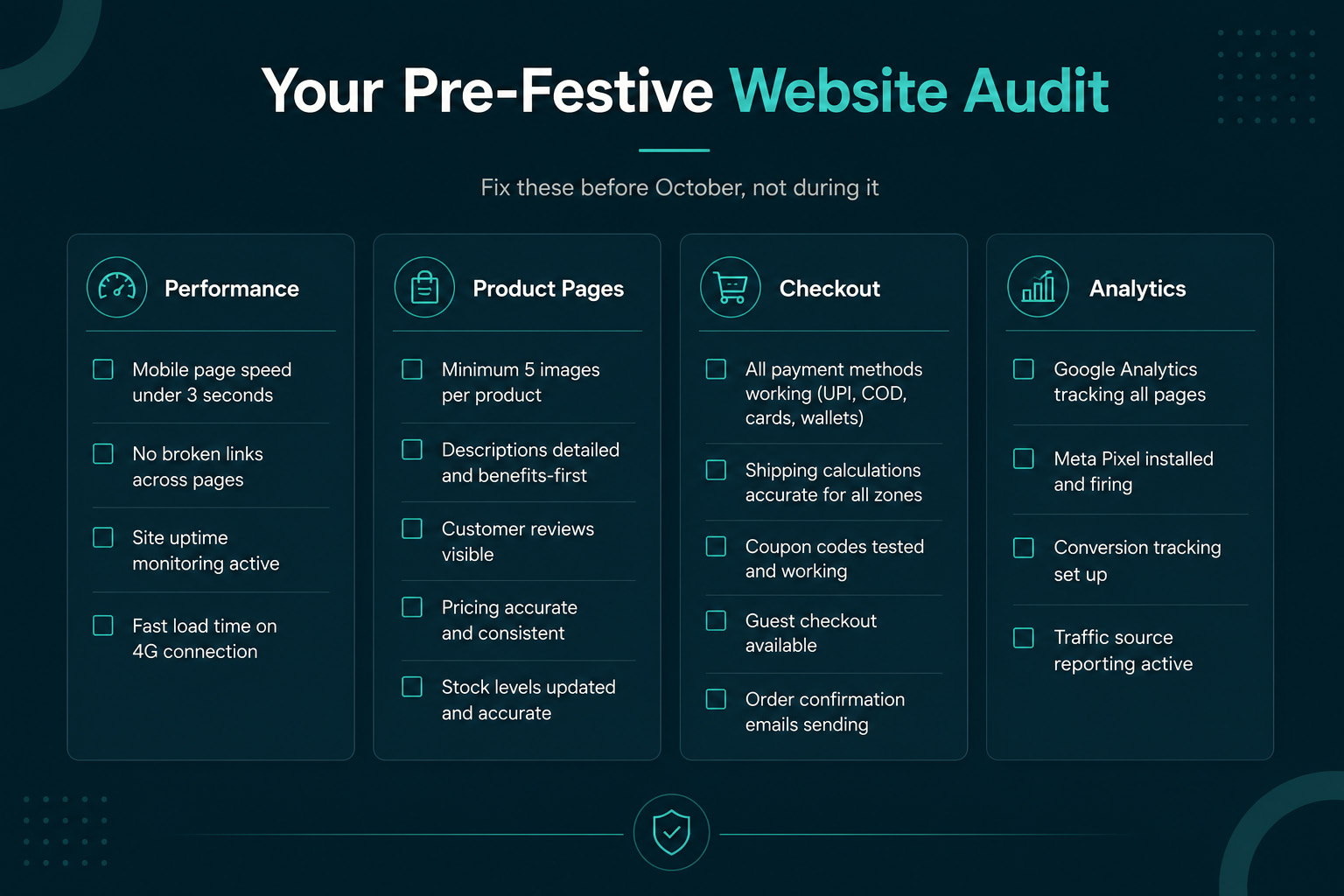
The worst time to discover a slow-loading page or broken checkout is during Diwali week when traffic is at its highest. A website audit in July gives you 3-4 months to fix anything that could hurt conversion during the festive season.
Work through these four areas systematically:
Performance:
• Mobile page speed (target under 3 seconds via Google PageSpeed Insights)
• Broken links across product pages, category pages, and navigation
• Site uptime monitoring to catch any downtime before peak traffic hits
Product Pages:
• Images: minimum 5 per product, festive lifestyle images where relevant
• Descriptions: detailed, benefits-first, keyword-optimized
• Reviews: visible and current
• Pricing: accurate and consistent across all pages
• Stock availability: reflects actual inventory levels
Checkout:
• All payment methods working: UPI, COD, cards, wallets
• Shipping calculations accurate for all delivery zones
• Coupon codes tested and functioning
• Guest checkout available (requiring account creation kills mobile conversions)
Analytics:
• Google Analytics tracking all pages and events
• Meta Pixel installed and firing correctly
• Conversion tracking set up so festive campaign results can be measured accurately
Work through these four areas systematically:
Performance:
• Mobile page speed (target under 3 seconds via Google PageSpeed Insights)
• Broken links across product pages, category pages, and navigation
• Site uptime monitoring to catch any downtime before peak traffic hits
Product Pages:
• Images: minimum 5 per product, festive lifestyle images where relevant
• Descriptions: detailed, benefits-first, keyword-optimized
• Reviews: visible and current
• Pricing: accurate and consistent across all pages
• Stock availability: reflects actual inventory levels
Checkout:
• All payment methods working: UPI, COD, cards, wallets
• Shipping calculations accurate for all delivery zones
• Coupon codes tested and functioning
• Guest checkout available (requiring account creation kills mobile conversions)
Analytics:
• Google Analytics tracking all pages and events
• Meta Pixel installed and firing correctly
• Conversion tracking set up so festive campaign results can be measured accurately
2. Inventory Planning: Stock What Will Actually Sell
Running out of your best-selling products on Dhanteras is one of the most preventable revenue losses in ecommerce. Planning inventory in July means you have time to place orders, wait for production, and still have buffer stock before the season starts.
Start by categorizing your current catalog into five buckets based on last year's performance and upcoming festive demand:
• Fast movers: Products that sold quickly and consistently – prioritize reordering with 30-40% buffer above last year's peak
• Slow movers: Products that sold but took time – order conservatively, focus marketing effort elsewhere
• Dead stock: Products that barely moved – don't reorder, run clearance before festive season to free up cash and storage
• Seasonal products: Items that spike specifically during festive period – research trends now, order early
• Bundle opportunities: Products that sell separately but could be packaged together as festive gift sets
Beyond the what, plan the when and how much. Most suppliers need 3-6 weeks for production and delivery. Build in a buffer for delays. Calculate your storage capacity before ordering, receiving 500 units you have no space for creates new problems.
Amazon Smart Commerce's inventory dashboard gives you a centralized view of current stock levels across all SKUs. Review this now, identify what needs to be reordered, and build that 20-30% buffer above expected peak demand.
Start by categorizing your current catalog into five buckets based on last year's performance and upcoming festive demand:
• Fast movers: Products that sold quickly and consistently – prioritize reordering with 30-40% buffer above last year's peak
• Slow movers: Products that sold but took time – order conservatively, focus marketing effort elsewhere
• Dead stock: Products that barely moved – don't reorder, run clearance before festive season to free up cash and storage
• Seasonal products: Items that spike specifically during festive period – research trends now, order early
• Bundle opportunities: Products that sell separately but could be packaged together as festive gift sets
Beyond the what, plan the when and how much. Most suppliers need 3-6 weeks for production and delivery. Build in a buffer for delays. Calculate your storage capacity before ordering, receiving 500 units you have no space for creates new problems.
Amazon Smart Commerce's inventory dashboard gives you a centralized view of current stock levels across all SKUs. Review this now, identify what needs to be reordered, and build that 20-30% buffer above expected peak demand.

3. Product Photography: Festive Context Changes Everything
The same product that sells at a steady pace through the year can dramatically outperform during the festive season when presented in the right context.
A brass diya on a white background is just a product. The same diya photographed against a Diwali-decorated setting becomes a purchase decision.
A brass diya on a white background is just a product. The same diya photographed against a Diwali-decorated setting becomes a purchase decision.

Photographers and studios book out by August for festive shoots. Scheduling in July means you get access, time, and often better rates.
Identify which products need festive photography, that’s typically your top 20-30 best-selling products and any new launches planned for the season.
Start by creating a mood board for the aesthetic you want: warm lighting, traditional props, festive color palettes. If you're using Amazon Smart Commerce's AI Catalog Agent, this is also the time to generate lifestyle image variations for your festive collection so every product enters the season looking its best.
Identify which products need festive photography, that’s typically your top 20-30 best-selling products and any new launches planned for the season.
Start by creating a mood board for the aesthetic you want: warm lighting, traditional props, festive color palettes. If you're using Amazon Smart Commerce's AI Catalog Agent, this is also the time to generate lifestyle image variations for your festive collection so every product enters the season looking its best.
4. SEO and Festive Discovery
Most sellers focus on paid campaigns for the festive quarter and ignore organic discovery entirely. That's a missed opportunity because festive-intent searches spike weeks before the season starts, and organic content takes time to rank.
A few things worth setting up now:
Festive landing pages for your key collections (Diwali gifting, Navratri fashion, festive home decor) give Google something to index and rank before October traffic peaks.
Gift guides targeting searches like "Diwali gifts under ₹500" or "best Dhanteras gifting ideas" capture customers early in their research phase.
Seasonal keywords integrated into product descriptions, category page copy, and meta tags improve visibility for festive-intent searches that generic year-round copy won't capture.
Collection pages grouping products by festive occasion make navigation easier for customers and give search engines clear signals about content relevance.
Internal linking between gift guides, landing pages, and product pages keeps customers moving deeper into the store rather than bouncing after one page.
A few things worth setting up now:
Festive landing pages for your key collections (Diwali gifting, Navratri fashion, festive home decor) give Google something to index and rank before October traffic peaks.
Gift guides targeting searches like "Diwali gifts under ₹500" or "best Dhanteras gifting ideas" capture customers early in their research phase.
Seasonal keywords integrated into product descriptions, category page copy, and meta tags improve visibility for festive-intent searches that generic year-round copy won't capture.
Collection pages grouping products by festive occasion make navigation easier for customers and give search engines clear signals about content relevance.
Internal linking between gift guides, landing pages, and product pages keeps customers moving deeper into the store rather than bouncing after one page.
5. Customer Segmentation: Know Who You're Talking to Before You Talk
A strong festive marketing strategy isn't about sending the same offer to everyone. It's about sending the right message to the right customer at the right moment. That requires segmented data built in advance, not assembled at the last minute.
Use Amazon Smart Commerce's Customer Segments to build and export these five audiences now:
• Last year's festive buyers: Highest likelihood of purchasing again this season. Give them early access before campaigns go public.
• Abandoned cart customers: Warm leads who showed intent but didn't convert. A well-timed reminder with a festive offer often closes these.
• High-value customers: Your top spenders deserve VIP treatment - exclusive previews, higher discounts, early sale access before general announcement.
• One-time buyers: Customers who bought once and went quiet. The festive season is an ideal moment for cross-sell campaigns, introducing them to complementary categories.
• Inactive customers: Anyone who hasn't bought in 6+ months needs a stronger win-back incentive - a meaningful discount or a new collection announcement gives them a reason to return.
Building these segments in July means festive campaigns in October launch with precision instead of broad blasts that drain budget on low-intent audiences.
Use Amazon Smart Commerce's Customer Segments to build and export these five audiences now:
• Last year's festive buyers: Highest likelihood of purchasing again this season. Give them early access before campaigns go public.
• Abandoned cart customers: Warm leads who showed intent but didn't convert. A well-timed reminder with a festive offer often closes these.
• High-value customers: Your top spenders deserve VIP treatment - exclusive previews, higher discounts, early sale access before general announcement.
• One-time buyers: Customers who bought once and went quiet. The festive season is an ideal moment for cross-sell campaigns, introducing them to complementary categories.
• Inactive customers: Anyone who hasn't bought in 6+ months needs a stronger win-back incentive - a meaningful discount or a new collection announcement gives them a reason to return.
Building these segments in July means festive campaigns in October launch with precision instead of broad blasts that drain budget on low-intent audiences.
6. Shipping Readiness: Can Your Delivery Keep Up With Demand?
During peak festive weeks, delivery delays aren't just operational problems, they're brand perception problems. A customer who ordered a Diwali gift that arrived after Diwali won't order again.
Review your logistics setup now. If you're using Amazon logistics support through Amazon Smart Commerce, understand the peak-period timelines and any additional processes required during high-volume weeks.
If you're managing shipping independently, evaluate whether your current courier partner can handle 5-10x your normal daily order volume. Identify backup options in case primary partners face delays. Stock sufficient packaging material well in advance, this detail derails a surprisingly high number of sellers during peak season.
Set customer expectations clearly on product pages. Honest delivery timelines during the festive season, even if slightly longer than usual, build more trust than optimistic estimates that don't hold.
Finally, set up order tracking notifications. Customers who receive proactive shipping updates - order confirmed, dispatched, out for delivery - generate significantly fewer support queries and report better post-purchase experience. This matters especially when gifting is involved, and timing is emotionally important to the customer.
Review your logistics setup now. If you're using Amazon logistics support through Amazon Smart Commerce, understand the peak-period timelines and any additional processes required during high-volume weeks.
If you're managing shipping independently, evaluate whether your current courier partner can handle 5-10x your normal daily order volume. Identify backup options in case primary partners face delays. Stock sufficient packaging material well in advance, this detail derails a surprisingly high number of sellers during peak season.
Set customer expectations clearly on product pages. Honest delivery timelines during the festive season, even if slightly longer than usual, build more trust than optimistic estimates that don't hold.
Finally, set up order tracking notifications. Customers who receive proactive shipping updates - order confirmed, dispatched, out for delivery - generate significantly fewer support queries and report better post-purchase experience. This matters especially when gifting is involved, and timing is emotionally important to the customer.
7. Marketing Calendar: Map Every Campaign Before October Arrives
Every campaign needs 4-6 weeks of creative preparation before it goes live, making July the right time to map the full festive calendar. For each date, decide what you're promoting, what offer you're running, which segment receives which message, and which channels carry the campaign.
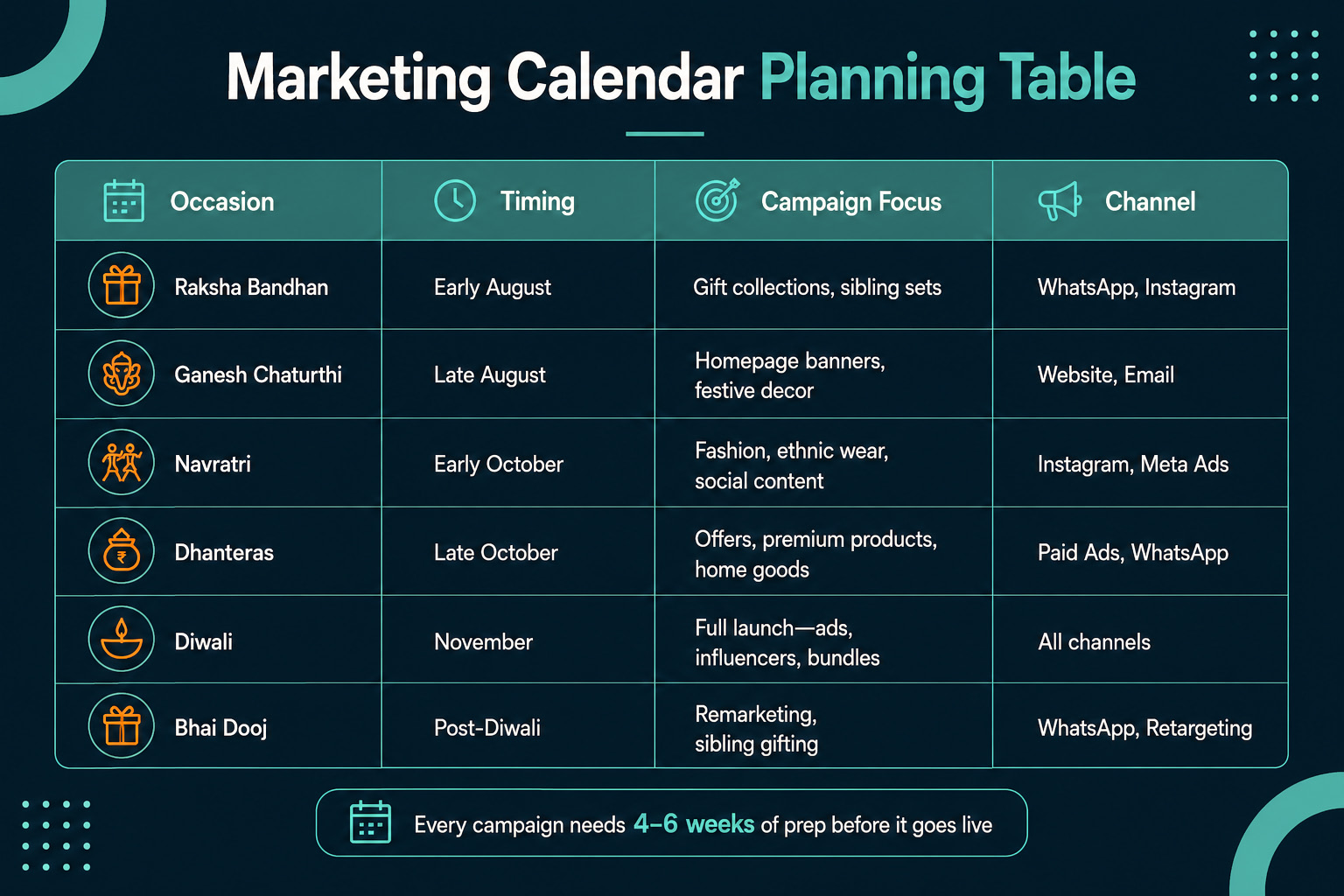
Building this calendar in July means campaigns that are thoughtful and well-produced instead of rushed and generic, and that difference shows directly in conversion rates.
8. Pricing and Offers: Decide Your Strategy Before the Season Starts
Most sellers figure out their discount strategy in the week before Diwali. That's too late to execute well and almost always results in either leaving money on the table with offers that were too conservative, or cutting margins too deeply with panic discounts.
Plan your pricing and offer strategy now so every campaign has a clear commercial logic behind it.
Discount strategy: Set a maximum discount percentage per category that still protects margin. Decide which products you're willing to discount heavily (slow movers, old stock) and which you're protecting (bestsellers, premium items).
Bundle offers and combos: Identify 3-5 product combinations that make natural gift sets. Festive bundles increase average order value and give customers a ready-made gifting solution, reducing decision fatigue and increasing conversion.
Free shipping thresholds: Decide what order value unlocks free shipping. This is one of the most effective ways to increase basket size without reducing per-unit price. Set the threshold at 20-30% above your current average order value.
Coupon strategy: Plan which coupon codes you'll use across which channels: exclusive codes for your WhatsApp list, separate codes for Meta ads, public codes for homepage banners. This lets you track which channels drive actual purchases rather than just traffic.
Cross-sell and upsell plan: Map which products you'll recommend alongside each bestseller. The Basket Building feature in Amazon Smart Commerce surfaces these recommendations automatically at checkout. Decide now which products get paired together.
Plan your pricing and offer strategy now so every campaign has a clear commercial logic behind it.
Discount strategy: Set a maximum discount percentage per category that still protects margin. Decide which products you're willing to discount heavily (slow movers, old stock) and which you're protecting (bestsellers, premium items).
Bundle offers and combos: Identify 3-5 product combinations that make natural gift sets. Festive bundles increase average order value and give customers a ready-made gifting solution, reducing decision fatigue and increasing conversion.
Free shipping thresholds: Decide what order value unlocks free shipping. This is one of the most effective ways to increase basket size without reducing per-unit price. Set the threshold at 20-30% above your current average order value.
Coupon strategy: Plan which coupon codes you'll use across which channels: exclusive codes for your WhatsApp list, separate codes for Meta ads, public codes for homepage banners. This lets you track which channels drive actual purchases rather than just traffic.
Cross-sell and upsell plan: Map which products you'll recommend alongside each bestseller. The Basket Building feature in Amazon Smart Commerce surfaces these recommendations automatically at checkout. Decide now which products get paired together.
The Best Festive Season You've Had Starts Now
A successful festive season isn't determined by luck or a bigger marketing budget - it's built on consistent preparation. Sellers who begin planning in July have the time to optimize their website, stock the right inventory, create compelling product content, segment their customers, and plan campaigns that drive results. Those who wait until September often spend their time solving last-minute challenges instead of focusing on growth.
The good news is that you don't have to do everything at once. Break your preparation into manageable milestones across July and August. Audit your website, finalize inventory plans, refresh product photography, organize your customer segments, and build your marketing calendar. By the time the festive shopping season begins, you'll be ready to launch with confidence while others are still catching up.
Whether you're preparing your first festive sale or scaling an established business, starting early gives you a significant advantage. With Amazon Smart Commerce, you can simplify key tasks such as inventory management, customer segmentation, website optimization, and performance tracking - helping you stay focused on growing your business instead of managing complexity.
The festive season rewards the sellers who prepare first. Make this the year you start early.
The good news is that you don't have to do everything at once. Break your preparation into manageable milestones across July and August. Audit your website, finalize inventory plans, refresh product photography, organize your customer segments, and build your marketing calendar. By the time the festive shopping season begins, you'll be ready to launch with confidence while others are still catching up.
Whether you're preparing your first festive sale or scaling an established business, starting early gives you a significant advantage. With Amazon Smart Commerce, you can simplify key tasks such as inventory management, customer segmentation, website optimization, and performance tracking - helping you stay focused on growing your business instead of managing complexity.
The festive season rewards the sellers who prepare first. Make this the year you start early.


COMPANY


Built in

© 2026 Amazon.com, Inc. or its affiliates. All rights reserved