
SEO in Ecommerce: A Practical Guide to Ranking Your Product Pages on Google
Every day, customers search Google for products they're ready to buy. The question is: do they find your store or your competitors'?
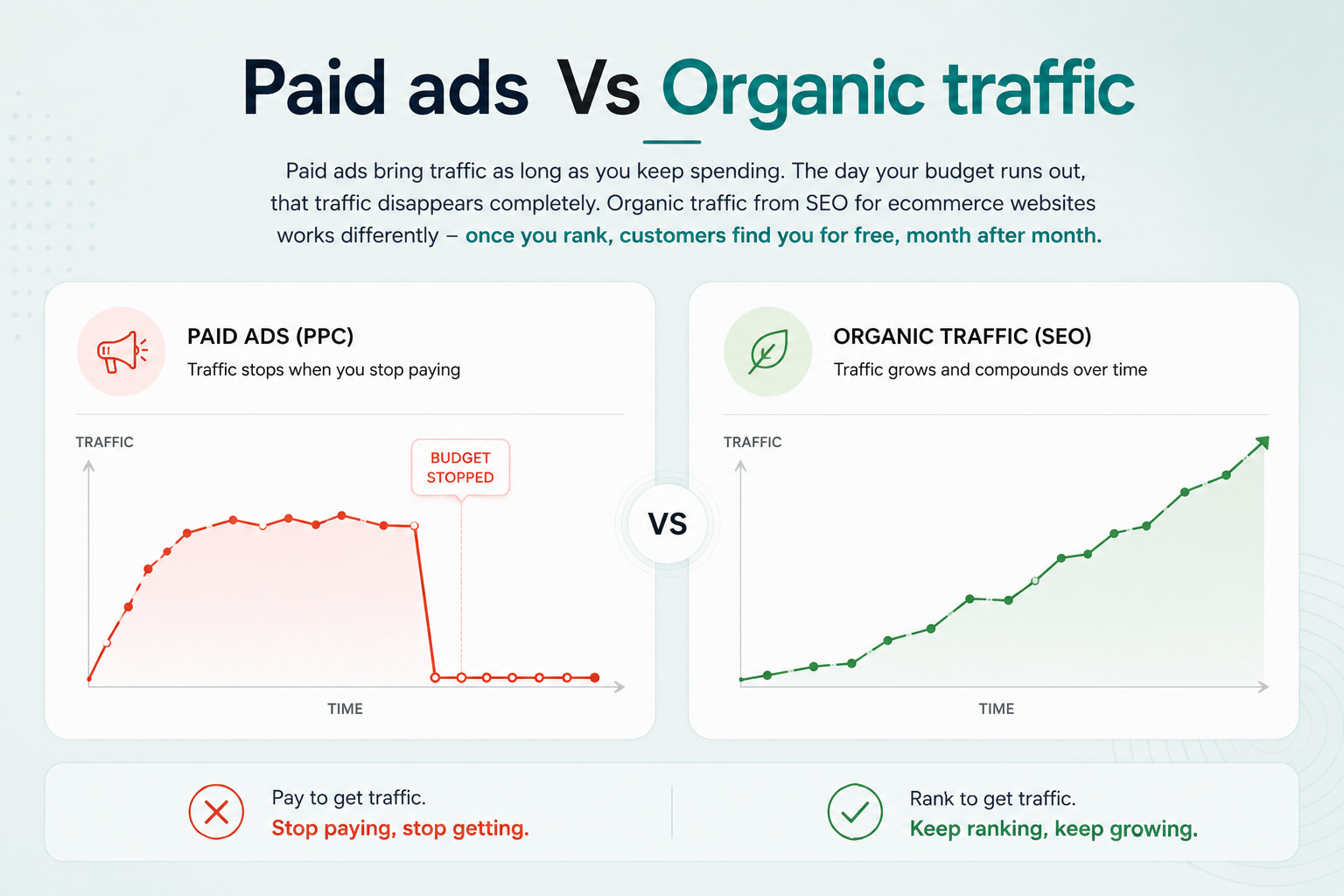
Unlike paid ads, organic search visibility can continue driving traffic long after the initial optimization work is done. That's why SEO remains one of the most effective growth channels for ecommerce brands.
Since a large share of ecommerce traffic in India comes from mobile devices, mobile optimization plays a critical role in both SEO and user experience.
This guide explores the product page optimization techniques that help ecommerce businesses improve visibility, attract organic traffic, and generate more sales.
Unlike paid ads, organic search visibility can continue driving traffic long after the initial optimization work is done. That's why SEO remains one of the most effective growth channels for ecommerce brands.
Since a large share of ecommerce traffic in India comes from mobile devices, mobile optimization plays a critical role in both SEO and user experience.
This guide explores the product page optimization techniques that help ecommerce businesses improve visibility, attract organic traffic, and generate more sales.
Why Product Page SEO Matters for Indian D2C
Let's talk about why SEO in ecommerce deserves your attention even when paid ads seem easier.
Organic traffic delivers ongoing ROI. You optimize a product page once and it brings customers for months or years. Paid visibility stops the moment you pause campaigns. Product page optimization builds an asset that compounds over time instead of renting temporary visibility.
Long tail strategy example searches convert better than generic terms. Someone searching "handmade silver jhumka earrings for women" has much higher buyer intent than someone just searching "earrings." These specific searches have lower competition and higher conversion rate for organic traffic growth because the customer already knows exactly what they want.
Building brand authority through consistent SERP presence matters more than most sellers realize. When customers see your brand appearing on page 1 for multiple related searches, trust builds automatically. You're not just another seller, you're the authority in your category.
India offers specific advantages that smart sellers can exploit. Regional language searches in Hindi, Tamil, Bengali, and other languages have less competition than English keywords. Tier-2 and tier-3 city targeting like "silver jewelry Surat" or "handmade bags Jaipur" connects you with customers that big brands ignore. Since a large share of ecommerce traffic in India comes from mobile devices, mobile optimization plays a critical role in both SEO and user experience.
Organic traffic delivers ongoing ROI. You optimize a product page once and it brings customers for months or years. Paid visibility stops the moment you pause campaigns. Product page optimization builds an asset that compounds over time instead of renting temporary visibility.
Long tail strategy example searches convert better than generic terms. Someone searching "handmade silver jhumka earrings for women" has much higher buyer intent than someone just searching "earrings." These specific searches have lower competition and higher conversion rate for organic traffic growth because the customer already knows exactly what they want.
Building brand authority through consistent SERP presence matters more than most sellers realize. When customers see your brand appearing on page 1 for multiple related searches, trust builds automatically. You're not just another seller, you're the authority in your category.
India offers specific advantages that smart sellers can exploit. Regional language searches in Hindi, Tamil, Bengali, and other languages have less competition than English keywords. Tier-2 and tier-3 city targeting like "silver jewelry Surat" or "handmade bags Jaipur" connects you with customers that big brands ignore. Since a large share of ecommerce traffic in India comes from mobile devices, mobile optimization plays a critical role in both SEO and user experience.
Ecommerce Keyword Research
Finding the right keywords doesn't require expensive tools or complex strategies. Start with Google Keyword Planner (free) to see what people search for in your product category. Ubersuggest is another free option with competitive data. For deeper analysis, Semrush and ahrefs (paid tools, starting around ₹5,000-10,000/month) show exactly which keywords competitors rank for.
The strategy is simple - start broad, then narrow to long-tail. "Silver earrings" means competing with every jewelry brand in India. "Handmade silver jhumka earrings for women" has lower competition and much higher buyer intent because the customer already knows exactly what they want.
Match keywords to search intent. Informational searches ("how to clean silver jewelry") belong on blog content. Transactional searches ("buy silver jhumka earrings online") go on product pages. Indian sellers have a genuine advantage here – regional language keywords, city-specific searches like "silver jewelry Surat," and festival keywords like "diwali gift jewelry" all have far less competition than generic English terms.
The strategy is simple - start broad, then narrow to long-tail. "Silver earrings" means competing with every jewelry brand in India. "Handmade silver jhumka earrings for women" has lower competition and much higher buyer intent because the customer already knows exactly what they want.
Match keywords to search intent. Informational searches ("how to clean silver jewelry") belong on blog content. Transactional searches ("buy silver jhumka earrings online") go on product pages. Indian sellers have a genuine advantage here – regional language keywords, city-specific searches like "silver jewelry Surat," and festival keywords like "diwali gift jewelry" all have far less competition than generic English terms.
Use Google's Free Search Data
Before investing in paid SEO tools, use Google's own search results for keyword ideas.
Type your product keyword into Google and pay attention to:
• Autocomplete suggestions
• People Also Ask questions
• Related Searches at the bottom of the page
These often reveal high-intent searches that customers are already using.
Type your product keyword into Google and pay attention to:
• Autocomplete suggestions
• People Also Ask questions
• Related Searches at the bottom of the page
These often reveal high-intent searches that customers are already using.
Product Page Optimization Checklist
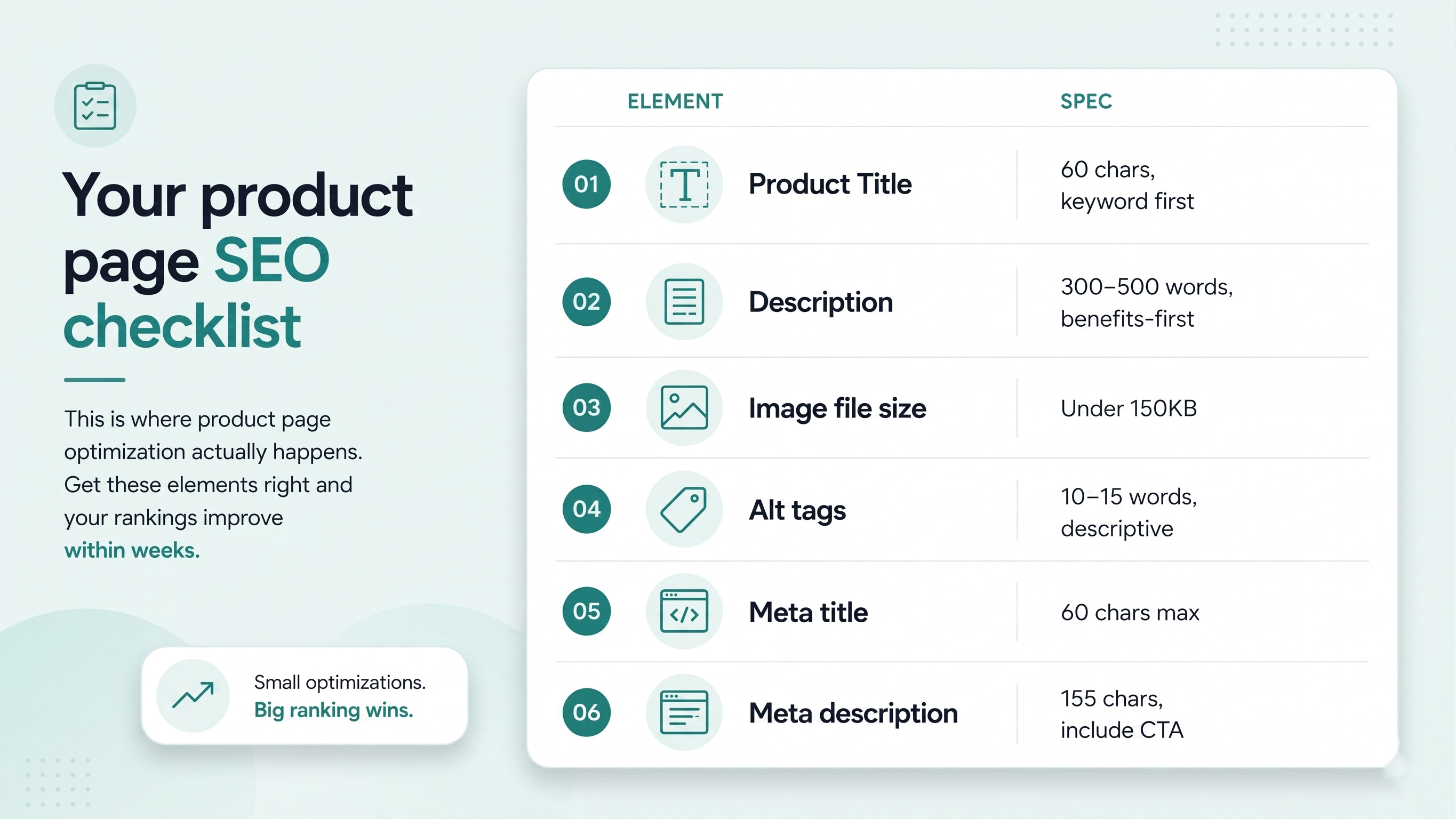
This is where product page optimization actually happens. Get these elements right and your rankings improve within weeks.
Write Product Titles That Rank and Convert
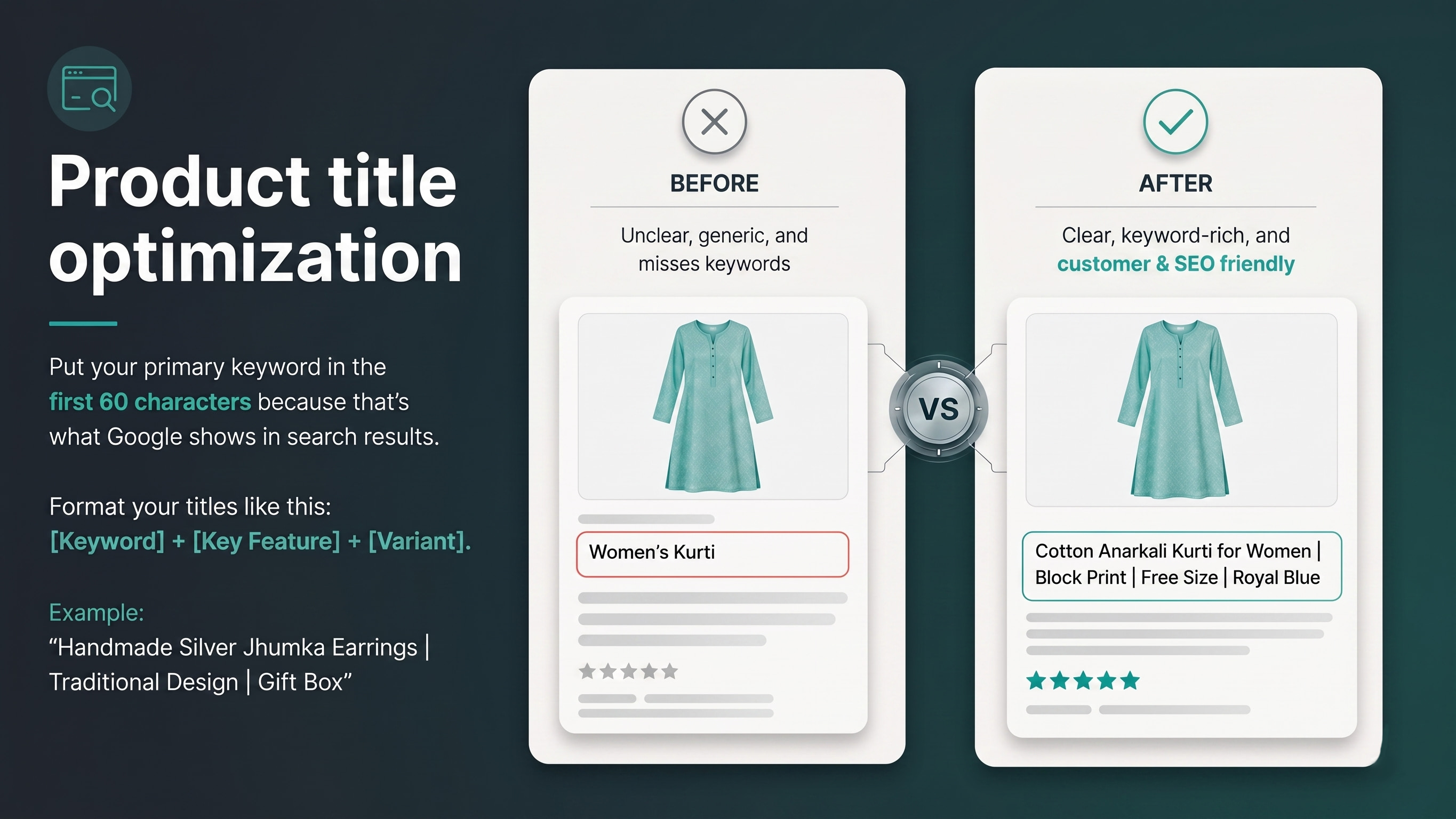
Your product title is one of the first things both search engines and shoppers notice, so make it clear, descriptive, and keyword-rich. Place your primary keyword near the beginning of the title, followed by important details such as the product type, material, size, color, or key feature. This helps search engines understand your product while giving customers the information they need at a glance.
For example, instead of "Beautiful Earrings", use "Handmade Silver Jhumka Earrings | Traditional Design | Gift Box." A well-structured title improves your chances of appearing in relevant search results and makes your product more appealing to potential buyers.
For example, instead of "Beautiful Earrings", use "Handmade Silver Jhumka Earrings | Traditional Design | Gift Box." A well-structured title improves your chances of appearing in relevant search results and makes your product more appealing to potential buyers.
Optimize Product Descriptions for SEO
Detailed product descriptions generally perform better than short, generic copy. Focus on answering customer questions, highlighting benefits, and providing enough information for shoppers to make confident purchase decisions.
Take a benefits-first approach - solve problems instead of just listing features. Don't say "925 sterling silver construction." Say "Won't turn your ears green or cause allergic reactions thanks to pure 925 sterling silver."
Use keywords naturally 3-5 times throughout the description without stuffing. Answer the questions customers actually ask: How do I use this? What are care instructions? Will this fit me? Does this work with what I already have?
Format everything for mobile with short paragraphs (2-3 sentences max) and bullet points for scannability. Remember, 80%+ of Indian traffic reads on phones.
Take a benefits-first approach - solve problems instead of just listing features. Don't say "925 sterling silver construction." Say "Won't turn your ears green or cause allergic reactions thanks to pure 925 sterling silver."
Use keywords naturally 3-5 times throughout the description without stuffing. Answer the questions customers actually ask: How do I use this? What are care instructions? Will this fit me? Does this work with what I already have?
Format everything for mobile with short paragraphs (2-3 sentences max) and bullet points for scannability. Remember, 80%+ of Indian traffic reads on phones.
Optimize Product Images for Search and Sales
File names matter for SEO. Name your images descriptively like "silver-jhumka-earrings-traditional.jpg" instead of generic names like IMG_1234.jpg. Google reads file names before analyzing images.
Alt tags describe images to search engines and screen readers. Write them like "Handmade silver jhumka earrings with intricate traditional design" instead of "product image." This is how you show up in Google Image Search.
Compression keeps pages fast. Get every image under 150KB without losing visible quality.
Quantity helps conversion and SEO. Include minimum 5 images: main product shot, lifestyle image, close-up showing details, size guide or dimension reference, and packaging shot.
Alt tags describe images to search engines and screen readers. Write them like "Handmade silver jhumka earrings with intricate traditional design" instead of "product image." This is how you show up in Google Image Search.
Compression keeps pages fast. Get every image under 150KB without losing visible quality.
Quantity helps conversion and SEO. Include minimum 5 images: main product shot, lifestyle image, close-up showing details, size guide or dimension reference, and packaging shot.
Write SEO-Friendly Meta Titles and Descriptions
Meta titles show up as the blue clickable link in Google search results. Keep them under 60 characters and include both your primary keyword and a compelling hook.
Meta descriptions appear as the gray text below the title. Keep them under 155 characters, include a clear CTA, and work in secondary keywords naturally.
Example: "Buy handmade silver jhumka earrings online. Traditional Indian design, free gift box. Shop authentic jewelry at best prices."
These elements combined transform average product pages into SEO optimised product descriptions that both rank well and convert browsers into buyers.
Meta descriptions appear as the gray text below the title. Keep them under 155 characters, include a clear CTA, and work in secondary keywords naturally.
Example: "Buy handmade silver jhumka earrings online. Traditional Indian design, free gift box. Shop authentic jewelry at best prices."
These elements combined transform average product pages into SEO optimised product descriptions that both rank well and convert browsers into buyers.
Build a Strong SEO Foundation
Technical SEO sounds complicated but it's really just making sure Google can crawl your site and customers can use it smoothly.
Site speed plays an important role in both rankings and user experience. Use Google PageSpeed Insights to identify issues affecting performance.
Quick improvements include:
• Compressing images
• Enabling lazy loading
• Minimizing unnecessary scripts
A significant portion of ecommerce traffic comes from mobile devices, making responsive design essential.
Focus on:
• Mobile-friendly layouts
• Readable text
• Easy-to-tap buttons
• Fast loading times-g.
Product schema markup helps search engines understand product information such as:
• Price
• Availability
• Reviews
This can improve how your products appear in search results.
Amazon Smart Commerce automatically adds structured product data, reducing technical setup requirements.
Core Technical SEO Basics
Ensure your store includes:
• HTTPS security
• XML sitemaps
• Clean URLs
• Canonical tags for product variants
Site speed plays an important role in both rankings and user experience. Use Google PageSpeed Insights to identify issues affecting performance.
Quick improvements include:
• Compressing images
• Enabling lazy loading
• Minimizing unnecessary scripts
A significant portion of ecommerce traffic comes from mobile devices, making responsive design essential.
Focus on:
• Mobile-friendly layouts
• Readable text
• Easy-to-tap buttons
• Fast loading times-g.
Product schema markup helps search engines understand product information such as:
• Price
• Availability
• Reviews
This can improve how your products appear in search results.
Amazon Smart Commerce automatically adds structured product data, reducing technical setup requirements.
Core Technical SEO Basics
Ensure your store includes:
• HTTPS security
• XML sitemaps
• Clean URLs
• Canonical tags for product variants
Build a Content Strategy That Drives Traffic
Beyond product pages, create blog content targeting informational keywords that builds topical authority. Category pages should have 200-300 word descriptions with keyword-rich content instead of just showing products. Encourage customer reviews on product pages because they create fresh content and social proof while naturally including keywords customers actually use.
Content Ideas for Ecommerce Brands
Not every customer is ready to buy immediately. Informational content can help attract shoppers earlier in their buying journey.
Useful content formats include:
• Buying guides
• Product comparison articles
• Gift guides
• How-to tutorials
• Product care tips
• Seasonal shopping guides
This content can improve topical authority while creating additional opportunities to link customers to relevant product pages.
Useful content formats include:
• Buying guides
• Product comparison articles
• Gift guides
• How-to tutorials
• Product care tips
• Seasonal shopping guides
This content can improve topical authority while creating additional opportunities to link customers to relevant product pages.
Top 4 SEO Mistakes Hurting Ecommerce Stores
Most sellers make the same mistakes that tank their keyword rankings. Here's what to avoid:
1. Thin product descriptions
The problem: 50-word generic descriptions that say nothing useful. These pages don't rank because Google sees them as low-value content.
The fix: Create unique, detailed descriptions that answer customer questions and explain benefits clearly.
2. Duplicate content across variants
The problem: Using the same description for blue shirt, red shirt, and green shirt. Google sees this as duplicate content and won't rank multiple versions.
The fix: Write unique descriptions for each variant highlighting what makes that specific option special, or use canonical tags telling Google which version is the "main" one.
3. Ignoring mobile optimization
The problem: Focusing only on desktop experience when 80%+ of traffic comes from mobile devices.
The fix: Use mobile-first approach, test everything on actual phones, make sure buttons are thumb-friendly and text is readable without zooming.
4. Missing schema markup
The problem: No rich snippets means your search results look plain compared to competitors showing star ratings and prices.
The fix: Implement product schema markup on all product pages so Google can show enhanced results that get more clicks.
1. Thin product descriptions
The problem: 50-word generic descriptions that say nothing useful. These pages don't rank because Google sees them as low-value content.
The fix: Create unique, detailed descriptions that answer customer questions and explain benefits clearly.
2. Duplicate content across variants
The problem: Using the same description for blue shirt, red shirt, and green shirt. Google sees this as duplicate content and won't rank multiple versions.
The fix: Write unique descriptions for each variant highlighting what makes that specific option special, or use canonical tags telling Google which version is the "main" one.
3. Ignoring mobile optimization
The problem: Focusing only on desktop experience when 80%+ of traffic comes from mobile devices.
The fix: Use mobile-first approach, test everything on actual phones, make sure buttons are thumb-friendly and text is readable without zooming.
4. Missing schema markup
The problem: No rich snippets means your search results look plain compared to competitors showing star ratings and prices.
The fix: Implement product schema markup on all product pages so Google can show enhanced results that get more clicks.
How Amazon Smart Commerce Simplifies SEO
Amazon Smart Commerce handles technical SEO automatically so you can focus on content and keywords instead of code. Auto-generated meta tags get optimized by AI based on your product content. Mobile-optimized themes include built-in speed optimization without requiring developer work. Automatic structured data implementation adds product schema markup to every page by default. Analytics track organic impressions, clicks, and keyword rankings showing exactly which SEO efforts work. Clean URL structure follows best practices automatically instead of messy URLs with random numbers.
Measuring SEO Success
Track these 4 metrics using Google search console and Google analytics:
• Impressions show whether you're appearing in search results at all. Rising impressions mean Google is showing your pages more often.
• Clicks reveal whether people actually click through to your site. Good meta titles and descriptions improve click-through rates.
• Keyword rankings track where your target keywords sit in search results. Monitor your top 10-20 keywords and watch them climb from page 3 to page 2 to page 1.
• Organic sales measure revenue directly from organic traffic so you know whether SEO actually drives business results, not just vanity metrics.
• Impressions show whether you're appearing in search results at all. Rising impressions mean Google is showing your pages more often.
• Clicks reveal whether people actually click through to your site. Good meta titles and descriptions improve click-through rates.
• Keyword rankings track where your target keywords sit in search results. Monitor your top 10-20 keywords and watch them climb from page 3 to page 2 to page 1.
• Organic sales measure revenue directly from organic traffic so you know whether SEO actually drives business results, not just vanity metrics.
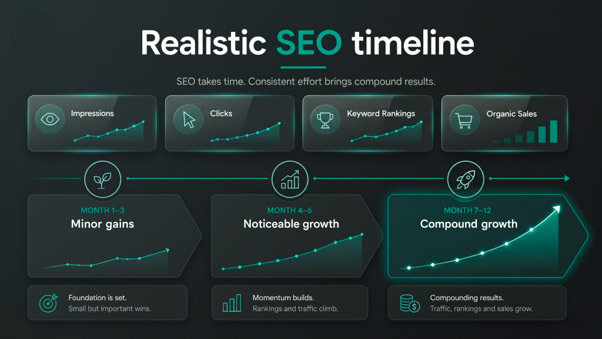
Timeline expectations: SEO usually takes 3-6 months to show meaningful results. Be patient and stay consistent with optimization.
Start Ranking Without Breaking the Bank
SEO in ecommerce is a marathon, not a sprint. Results take 3-6 months but they compound over time instead of disappearing like paid ads. Start with your top 20 revenue-generating products and optimize those first for maximum impact.
Consistency beats intensity and monthly optimization works better than one-time massive effort that you never revisit. Indian D2C brands have genuine advantages through less saturated long-tail keywords and regional targeting opportunities that big brands can't exploit.
Use Amazon Smart Commerce's built-in SEO tools and discover how proper ecommerce SEO strategies bring customers to your product pages month after month without spending much on ads.
Consistency beats intensity and monthly optimization works better than one-time massive effort that you never revisit. Indian D2C brands have genuine advantages through less saturated long-tail keywords and regional targeting opportunities that big brands can't exploit.
Use Amazon Smart Commerce's built-in SEO tools and discover how proper ecommerce SEO strategies bring customers to your product pages month after month without spending much on ads.


COMPANY


Built in

© 2026 Amazon.com, Inc. or its affiliates. All rights reserved