
The Real Cost of Building an eCommerce Website in India (2026)
The biggest mistake sellers make when calculating ecommerce website cost? Looking only at the development quote. Someone says ₹40,000, and it sounds manageable. But the real website development cost in India includes far more than the initial build. Add website hosting, payment processing fees, developer maintenance, inventory management software, marketing tools, and plugin subscriptions, and that ₹40,000 quote quietly becomes ₹1.5 lakhs or more by the end of the first year.
Understanding the full picture before you start means making smarter decisions about where to spend, what to include from day one, and which costs are genuinely avoidable.
Understanding the full picture before you start means making smarter decisions about where to spend, what to include from day one, and which costs are genuinely avoidable.
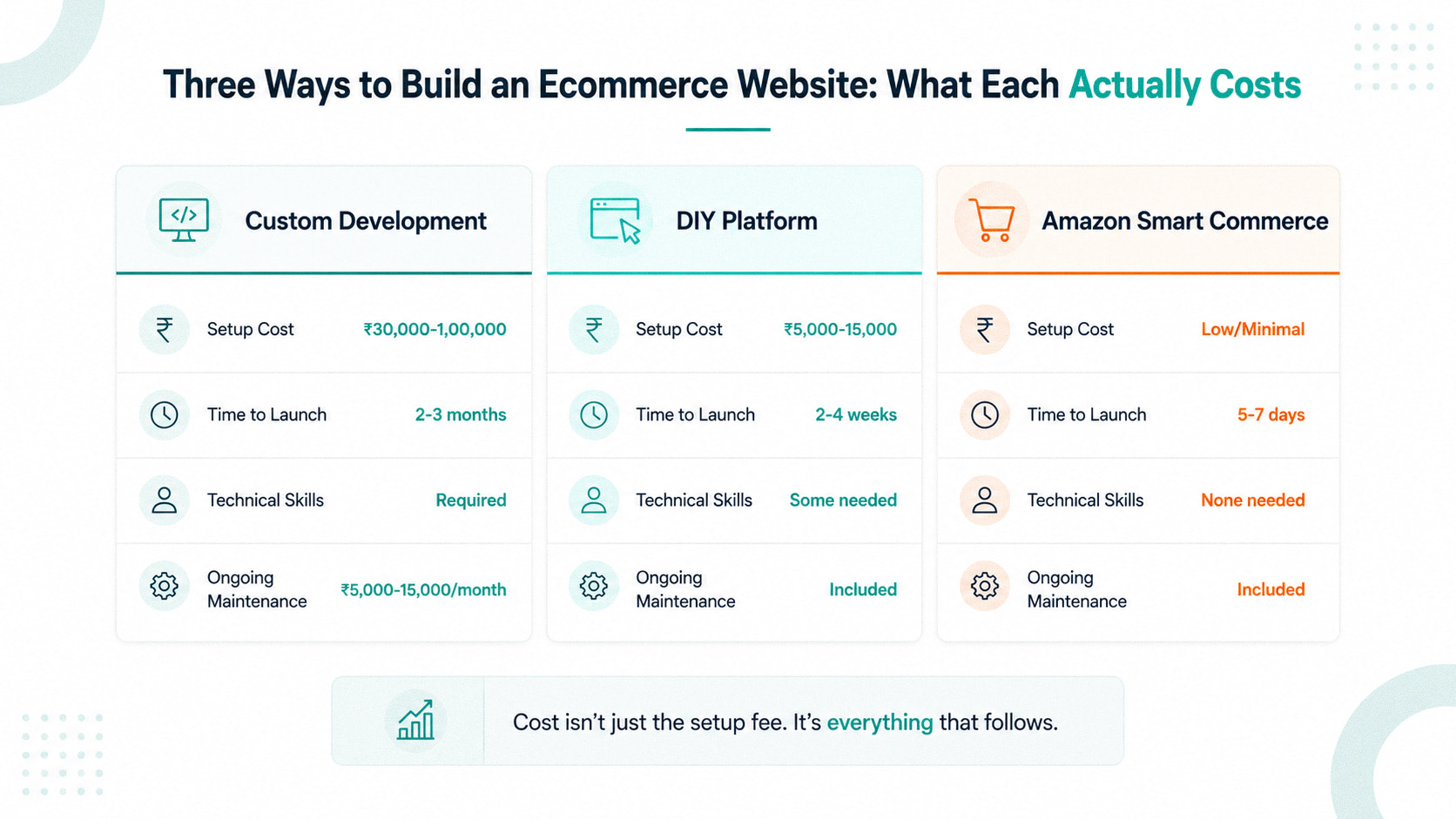
What Traditional Ecommerce Website Development Actually Costs
Hiring a developer or agency to build a custom ecommerce website from scratch is the most expensive route and the one that takes the longest to generate returns.
Custom development gives you flexibility, but flexibility comes with higher upfront investment and long-term maintenance responsibilities.
Custom development gives you flexibility, but flexibility comes with higher upfront investment and long-term maintenance responsibilities.
Upfront Development Cost by Catalog Size
Catalog Size
Small (under 50 products)
Medium (50-200 products)
Large with custom features
Estimated Development Cost
₹30,000-60,000
₹60,000-1,50,000
₹1,50,000-5,00,000+
These are upfront costs only. What follows is where most sellers get surprised.
Ongoing Costs After Launch
Cost Item
Developer maintenance
Website hosting (shared)
Website hosting (dedicated)
SSL certificate
Lost revenue during the 2-3 month build
Estimated Monthly/Annual Cost
₹5,000-15,000/month
₹3,000-12,000/year
₹15,000-50,000/year
₹1,000-5,000/year
Variable
Even small changes after launch – updating banners, adding a new landing page, or modifying the checkout flow – often require developer support, increasing both costs and turnaround time.
The Hidden Costs Sellers Don't See Coming
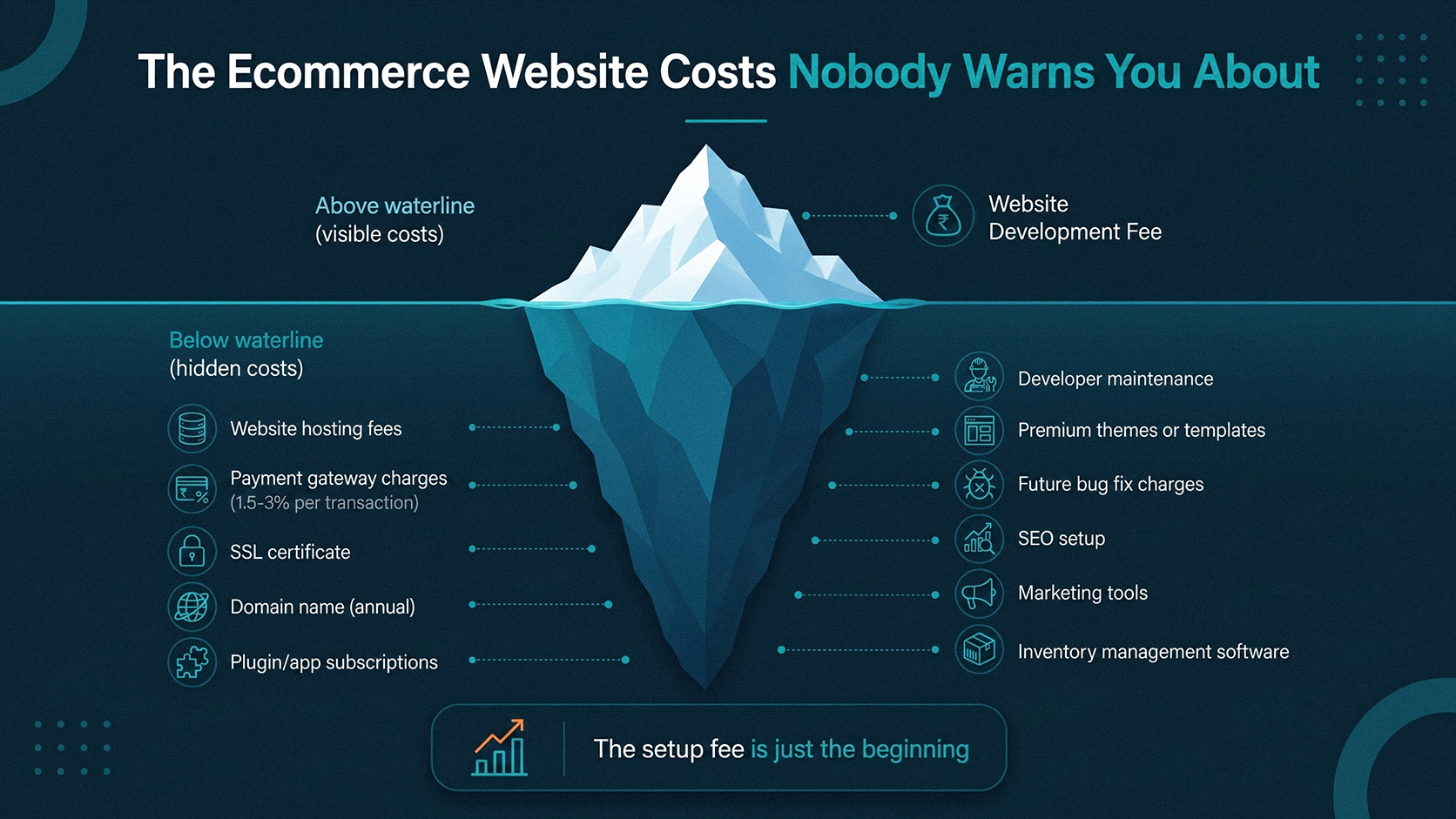
Whether you build custom or use an ecommerce platform, several costs sit below the surface and significantly affect the real price of running an online store.
Payment gateway charges are one of the most overlooked ecommerce costs. While they seem small on individual orders, they become significant as your sales grow. Every transaction processed carries a fee of 1.5-3% of the transaction value. On ₹5 lakhs in monthly revenue, that's ₹7,500-15,000 per month going to payment processing before anything else is accounted for.
Plugin and app subscriptions add up faster than most sellers expect. An SEO plugin, a reviews tool, a shipping calculator, a wishlist feature, and an abandoned cart recovery tool – each costs ₹500-3,000 per month individually. Many sellers eventually discover they're paying for multiple apps that solve problems their platform didn't solve out of the box.
Inventory management software catches growing sellers off guard. Once a catalog grows past 30-40 products, manual tracking breaks down. Dedicated tools cost ₹2,000-8,000 per month, depending on catalog size and features.
Premium themes or templates are another cost that many sellers don't anticipate. A professional-looking storefront on most platforms requires purchasing a premium theme, typically ₹3,000-15,000 upfront, with occasional upgrade costs as platforms update.
Post-launch development requests often become an ongoing expense that many businesses underestimate during budgeting. Sellers who build custom often find themselves spending ₹10,000-30,000 per year on post-launch changes they hadn't budgeted for.
Marketing and SEO tools layer on top of everything else. Email platforms, scheduling tools, analytics setup, and basic SEO software each carry monthly fees that collectively add ₹3,000-8,000 per month.
When every recurring cost is included, the total first-year investment for a custom ecommerce website typically reaches ₹1.5 – 3 lakhs, not the ₹40,000 many sellers initially budget for.
Payment gateway charges are one of the most overlooked ecommerce costs. While they seem small on individual orders, they become significant as your sales grow. Every transaction processed carries a fee of 1.5-3% of the transaction value. On ₹5 lakhs in monthly revenue, that's ₹7,500-15,000 per month going to payment processing before anything else is accounted for.
Plugin and app subscriptions add up faster than most sellers expect. An SEO plugin, a reviews tool, a shipping calculator, a wishlist feature, and an abandoned cart recovery tool – each costs ₹500-3,000 per month individually. Many sellers eventually discover they're paying for multiple apps that solve problems their platform didn't solve out of the box.
Inventory management software catches growing sellers off guard. Once a catalog grows past 30-40 products, manual tracking breaks down. Dedicated tools cost ₹2,000-8,000 per month, depending on catalog size and features.
Premium themes or templates are another cost that many sellers don't anticipate. A professional-looking storefront on most platforms requires purchasing a premium theme, typically ₹3,000-15,000 upfront, with occasional upgrade costs as platforms update.
Post-launch development requests often become an ongoing expense that many businesses underestimate during budgeting. Sellers who build custom often find themselves spending ₹10,000-30,000 per year on post-launch changes they hadn't budgeted for.
Marketing and SEO tools layer on top of everything else. Email platforms, scheduling tools, analytics setup, and basic SEO software each carry monthly fees that collectively add ₹3,000-8,000 per month.
When every recurring cost is included, the total first-year investment for a custom ecommerce website typically reaches ₹1.5 – 3 lakhs, not the ₹40,000 many sellers initially budget for.
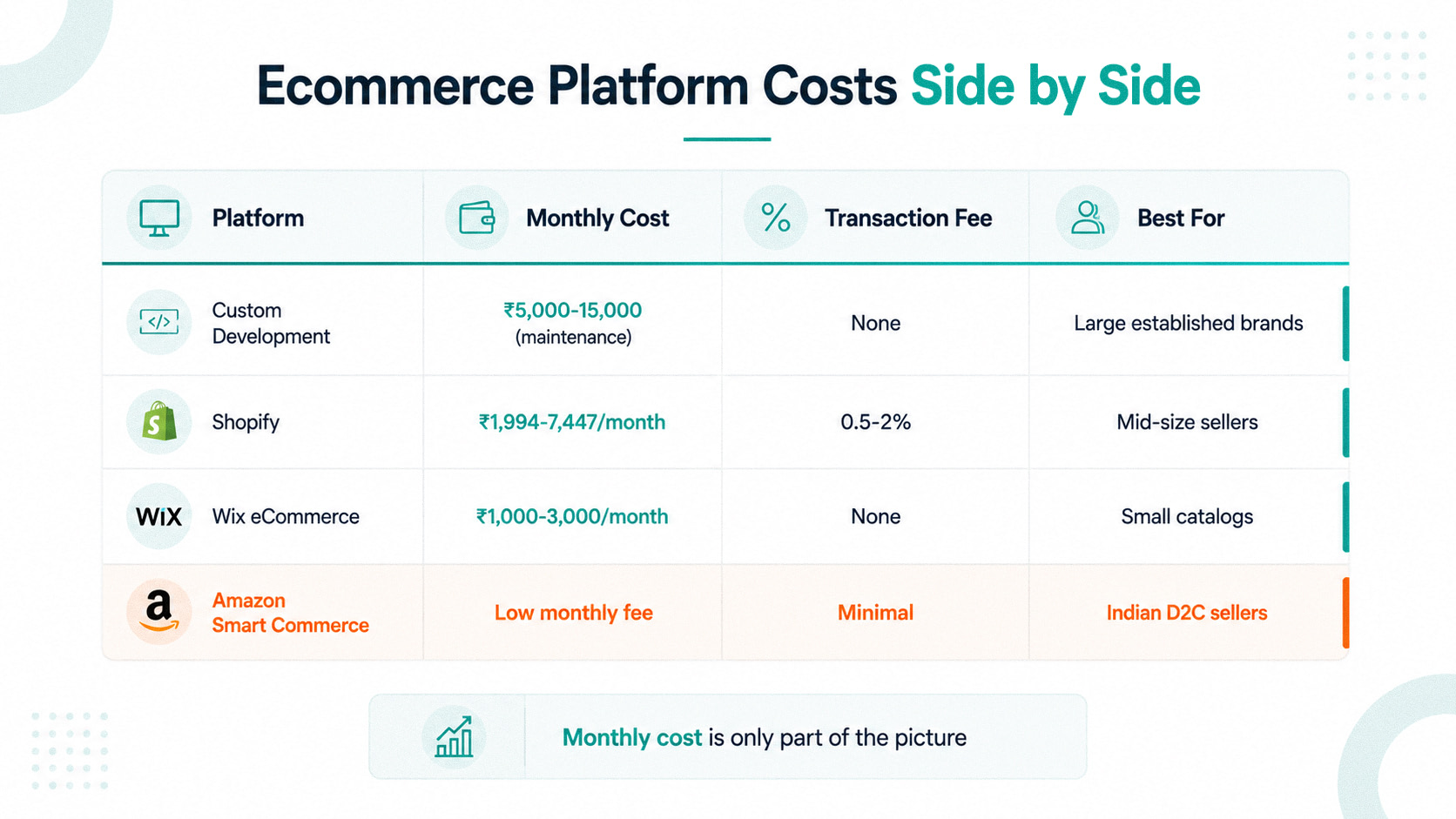
Ecommerce Platform Options and What They Cost
Using an ecommerce website builder reduces upfront costs significantly but introduces its own cost structure worth understanding before committing.
Shopify is one of the most widely used international ecommerce platform options for Indian sellers. Plans run from roughly ₹1,994 to ₹7,447 per month, with transaction fees on top if you don't use their native payment gateway. Additional apps for reviews, SEO, subscriptions, and marketing can substantially increase monthly costs.
Wix eCommerce starts lower at around ₹1,000-3,000 per month for business plans and suits smaller catalogs well. Scaling beyond 100-200 products or building more complex purchase flows starts requiring plan upgrades and additional tools.
WooCommerce is free to install, but running a production-ready store requires paid hosting, themes, plugins, and ongoing maintenance. Technical knowledge is also needed for setup and ongoing management.
Each platform solves the development cost problem, but shifts spending toward monthly subscriptions, app fees, and the time required to learn and maintain the system.
Shopify is one of the most widely used international ecommerce platform options for Indian sellers. Plans run from roughly ₹1,994 to ₹7,447 per month, with transaction fees on top if you don't use their native payment gateway. Additional apps for reviews, SEO, subscriptions, and marketing can substantially increase monthly costs.
Wix eCommerce starts lower at around ₹1,000-3,000 per month for business plans and suits smaller catalogs well. Scaling beyond 100-200 products or building more complex purchase flows starts requiring plan upgrades and additional tools.
WooCommerce is free to install, but running a production-ready store requires paid hosting, themes, plugins, and ongoing maintenance. Technical knowledge is also needed for setup and ongoing management.
Each platform solves the development cost problem, but shifts spending toward monthly subscriptions, app fees, and the time required to learn and maintain the system.
The Image Showcase Widget complements that story with immersive lifestyle imagery. Instead of displaying products against plain white backgrounds, sellers can showcase them in real-world settings that create context, build aspiration, and help customers imagine the product in their own lives.
For example:
• A home décor brand can showcase a beautifully styled living room featuring multiple products.
• A fashion brand can create a complete seasonal look.
• A skincare brand can present an everyday self-care routine instead of individual products.
Customers aren't simply buying products-they're buying the lifestyle those products represent.
Together, these widgets give independent sellers visual storytelling capabilities that previously required expensive custom development or enterprise ecommerce platforms.
For example:
• A home décor brand can showcase a beautifully styled living room featuring multiple products.
• A fashion brand can create a complete seasonal look.
• A skincare brand can present an everyday self-care routine instead of individual products.
Customers aren't simply buying products-they're buying the lifestyle those products represent.
Together, these widgets give independent sellers visual storytelling capabilities that previously required expensive custom development or enterprise ecommerce platforms.
What Amazon Smart Commerce Costs vs The Traditional Route
Amazon Smart Commerce brings together many of the tools sellers would otherwise purchase separately, reducing both software costs and operational complexity.
Instead of assembling multiple subscriptions and integrations, sellers get core ecommerce capabilities from day one.
Here's how that compares directly to the traditional setup:
Instead of assembling multiple subscriptions and integrations, sellers get core ecommerce capabilities from day one.
Here's how that compares directly to the traditional setup:
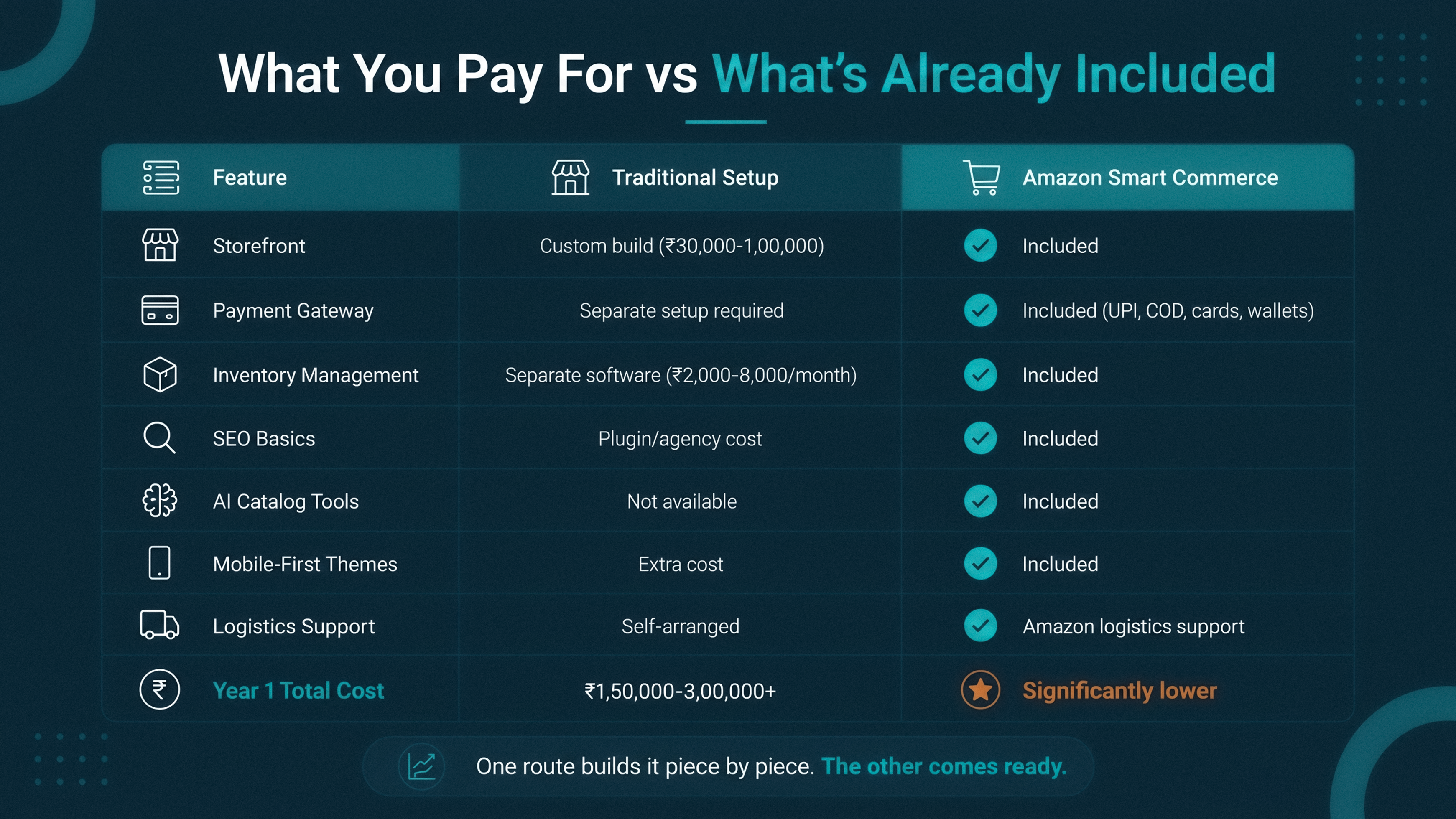
For an ecommerce business in the early or growth stage, the math consistently favors platforms where core infrastructure is included. What typically costs ₹1.5-3 lakhs in year one through the traditional route is bundled into a single online selling platform built for the Indian market, with payments, logistics, SEO, and inventory management already in place on day one.
What You Actually Need vs What's Nice to Have
Before spending anything on an ecommerce website, separating must-haves from nice-to-haves saves significant money in the early months.
Must-haves from day one:
• Mobile-optimized storefront
• Payment gateway with UPI and COD
• Product pages with proper images and descriptions
• Basic inventory tracking
• Order management and delivery
• Mobile-optimized storefront
• Payment gateway with UPI and COD
• Product pages with proper images and descriptions
• Basic inventory tracking
• Order management and delivery
Nice-to-have once revenue is established:
• Advanced analytics and reporting
• Email marketing integration
• Loyalty program tools
• Live chat support
• Advanced SEO plugins
• Advanced analytics and reporting
• Email marketing integration
• Loyalty program tools
• Live chat support
• Advanced SEO plugins
Most sellers over-invest in the second list before establishing the first. A clean, fast, mobile-optimized store with great product pages and reliable checkout converts better than a feature-heavy site that took three months and ₹2 lakhs to build.
How to Reduce Ecommerce Website Costs
Knowing where costs come from is half the solution. Here's how to actively manage them:
Start with a template before investing in a custom design. A well-chosen template or theme gets your store live faster and at a fraction of custom design costs. Custom design becomes worth investing in once you have revenue data showing what your store needs.
Prioritize essential features first. Launch with what customers actually need to complete a purchase: product pages, cart, checkout, payment, and order confirmation. Every additional feature should justify its cost by improving conversions, efficiency, or customer experience.
Audit and remove unused apps regularly. Most sellers accumulate subscriptions they no longer need. A quarterly audit of active plugins and apps typically reveals ₹3,000-8,000 in monthly spend that can be cut immediately.
Use integrated platforms where possible. Every separate tool you pay for – inventory software, payment gateway, shipping calculator, SEO plugin – is a subscription that an integrated platform often includes by default. Consolidating reduces both cost and operational complexity.
Plan for scalability from day one. Switching platforms after growth is one of the most expensive mistakes in e-commerce. Rebuilding a store that was never designed to scale costs far more than choosing the right platform initially. Choose a platform that can support where your business is headed, not just where it is today.
Start with a template before investing in a custom design. A well-chosen template or theme gets your store live faster and at a fraction of custom design costs. Custom design becomes worth investing in once you have revenue data showing what your store needs.
Prioritize essential features first. Launch with what customers actually need to complete a purchase: product pages, cart, checkout, payment, and order confirmation. Every additional feature should justify its cost by improving conversions, efficiency, or customer experience.
Audit and remove unused apps regularly. Most sellers accumulate subscriptions they no longer need. A quarterly audit of active plugins and apps typically reveals ₹3,000-8,000 in monthly spend that can be cut immediately.
Use integrated platforms where possible. Every separate tool you pay for – inventory software, payment gateway, shipping calculator, SEO plugin – is a subscription that an integrated platform often includes by default. Consolidating reduces both cost and operational complexity.
Plan for scalability from day one. Switching platforms after growth is one of the most expensive mistakes in e-commerce. Rebuilding a store that was never designed to scale costs far more than choosing the right platform initially. Choose a platform that can support where your business is headed, not just where it is today.
Spend on What Grows the Business, Not Just the Website
The real question around ecommerce website cost isn't "how do I spend the least?". It's "what does each rupee actually do for my business?"
Custom ecommerce website development offers maximum flexibility, but delays launch and ties ongoing costs to developer availability. DIY platforms offer faster setup but create subscription dependency. Integrated platforms prioritise speed, simplicity, and built-in infrastructure, helping businesses launch sooner and spend less time managing technology.
If your goal is to launch faster without juggling multiple tools and recurring subscriptions, Amazon Smart Commerce offers an integrated platform built specifically for Indian D2C brands.
Custom ecommerce website development offers maximum flexibility, but delays launch and ties ongoing costs to developer availability. DIY platforms offer faster setup but create subscription dependency. Integrated platforms prioritise speed, simplicity, and built-in infrastructure, helping businesses launch sooner and spend less time managing technology.
If your goal is to launch faster without juggling multiple tools and recurring subscriptions, Amazon Smart Commerce offers an integrated platform built specifically for Indian D2C brands.


COMPANY


Built in

© 2026 Amazon.com, Inc. or its affiliates. All rights reserved