
Best Ecommerce Website Builder in India: Step-by-Step Guide (2026)
Every ecommerce website builder claims to be the best. Great features, easy setup, quick growth, the works!
Choosing the right one feels overwhelming until you realize the right answer isn't about which platform is objectively best. It's about which platform is best for your specific situation.
What works for a fashion brand selling 20 handmade products might not work for a home decor brand managing 500 SKUs. Knowing what to look for before you start comparing platforms saves months of trial and error and potentially lakhs in sunk costs.
Here's how to choose the right ecommerce platform for your online business in 2026.
Choosing the right one feels overwhelming until you realize the right answer isn't about which platform is objectively best. It's about which platform is best for your specific situation.
What works for a fashion brand selling 20 handmade products might not work for a home decor brand managing 500 SKUs. Knowing what to look for before you start comparing platforms saves months of trial and error and potentially lakhs in sunk costs.
Here's how to choose the right ecommerce platform for your online business in 2026.
Ecommerce Portals in India vs Your Own Ecommerce Website
Ecommerce portals are online marketplaces where multiple sellers list products on a shared platform. In India, the major ones are Amazon, Flipkart, Meesho, and Myntra.
Millions of customers already browse and buy on these platforms daily, which makes them attractive for sellers who want immediate access to an existing audience without driving their own traffic.
The tradeoff is significant though. The marketplace owns the customer relationship, controls the shopping experience, limits your branding, charges commission on every sale, and places your products directly next to competitors selling the same category. Flipkart and Meesho are particularly price-competitive environments where margins get squeezed fast. Myntra works well for fashion but operates on its own terms around cataloging and content standards.
Many brands start by selling on these marketplaces and grow faster early on because of the built-in traffic. But most successful D2C brands eventually build their own ecommerce website alongside marketplace presence. Your own website gives you complete control over branding, pricing, and customer experience. You own the customer data, build direct relationships, and aren't subject to marketplace policy changes or fee increases. When a customer buys from your own website, you know exactly who they are and can market to them again.
The strongest position for most Indian D2C sellers is using both: marketplaces like Amazon, Flipkart, and Meesho for reach and discovery, your own website for relationship building, higher margins, and long-term brand equity.
Millions of customers already browse and buy on these platforms daily, which makes them attractive for sellers who want immediate access to an existing audience without driving their own traffic.
The tradeoff is significant though. The marketplace owns the customer relationship, controls the shopping experience, limits your branding, charges commission on every sale, and places your products directly next to competitors selling the same category. Flipkart and Meesho are particularly price-competitive environments where margins get squeezed fast. Myntra works well for fashion but operates on its own terms around cataloging and content standards.
Many brands start by selling on these marketplaces and grow faster early on because of the built-in traffic. But most successful D2C brands eventually build their own ecommerce website alongside marketplace presence. Your own website gives you complete control over branding, pricing, and customer experience. You own the customer data, build direct relationships, and aren't subject to marketplace policy changes or fee increases. When a customer buys from your own website, you know exactly who they are and can market to them again.
The strongest position for most Indian D2C sellers is using both: marketplaces like Amazon, Flipkart, and Meesho for reach and discovery, your own website for relationship building, higher margins, and long-term brand equity.

How to Choose the Best Ecommerce Website Builder
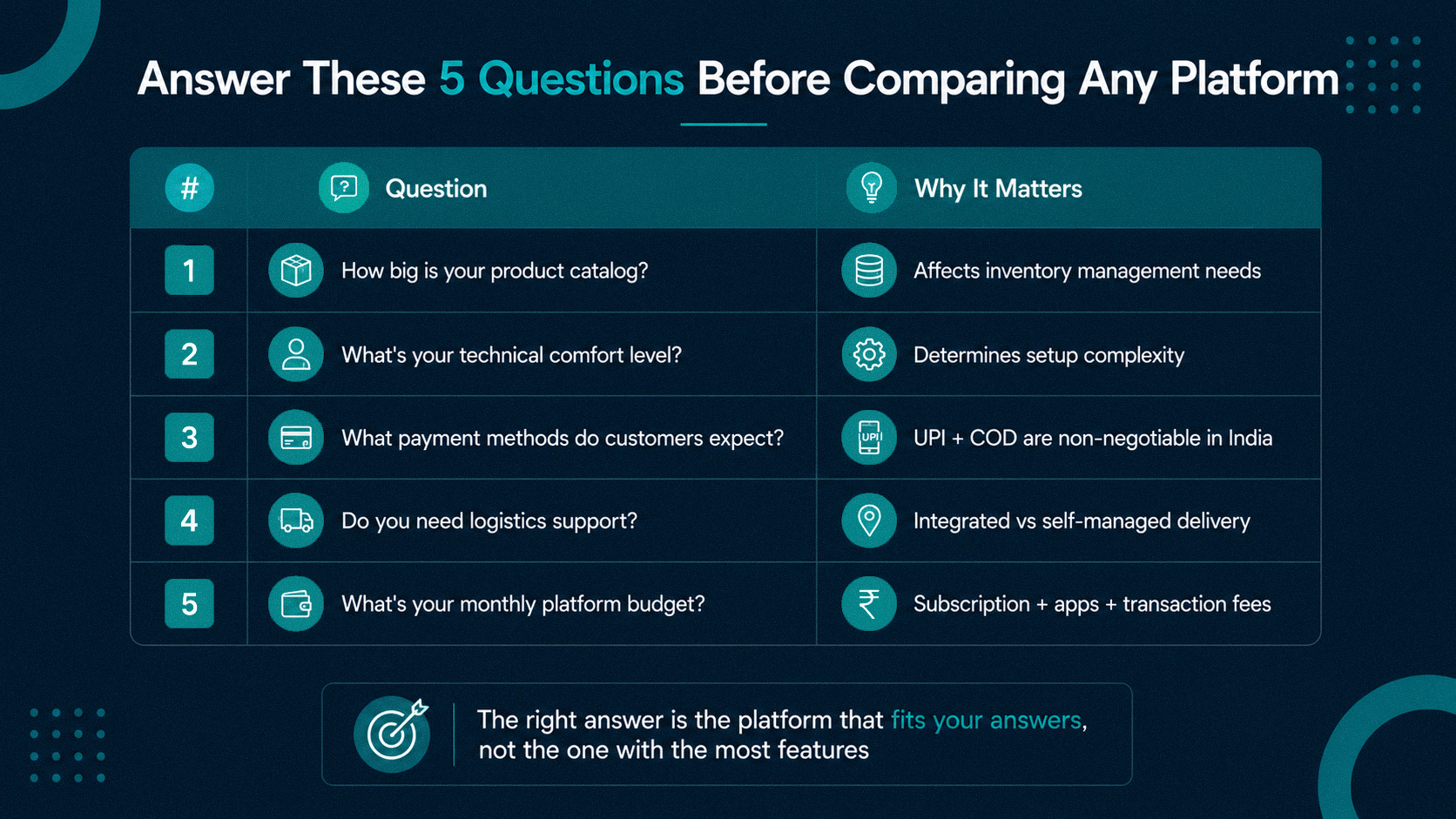
Before opening a single comparison article or watching a platform demo, answer these five questions about your business. The answers will eliminate half the options immediately.
How large is your product catalog? A platform built for 20 products handles differently than one managing 500 SKUs. Inventory management complexity scales with catalog size and not every platform handles large catalogs efficiently without additional tools.
What's your technical comfort level? Some platforms require coding knowledge for basic website customization. Others offer drag-and-drop builders where no technical skill is needed at all. Being honest about where you sit matters because choosing a platform above your comfort level means paying someone else to manage it indefinitely.
What payment methods do your customers expect? In India, UPI and COD are non-negotiable. Many international ecommerce website builder options require third-party plugins to support Indian payment methods, adding both cost and complexity.
Do you need logistics support or do you manage delivery yourself? Integrated logistics removes a significant operational burden for most early-stage sellers. If you're managing deliveries through courier partners independently, you need a platform with clean third-party logistics integration.
What's your monthly budget for platform costs? This includes subscription fees, transaction fees, app costs, and website hosting where applicable. The full cost picture matters more than the base subscription price alone.
How large is your product catalog? A platform built for 20 products handles differently than one managing 500 SKUs. Inventory management complexity scales with catalog size and not every platform handles large catalogs efficiently without additional tools.
What's your technical comfort level? Some platforms require coding knowledge for basic website customization. Others offer drag-and-drop builders where no technical skill is needed at all. Being honest about where you sit matters because choosing a platform above your comfort level means paying someone else to manage it indefinitely.
What payment methods do your customers expect? In India, UPI and COD are non-negotiable. Many international ecommerce website builder options require third-party plugins to support Indian payment methods, adding both cost and complexity.
Do you need logistics support or do you manage delivery yourself? Integrated logistics removes a significant operational burden for most early-stage sellers. If you're managing deliveries through courier partners independently, you need a platform with clean third-party logistics integration.
What's your monthly budget for platform costs? This includes subscription fees, transaction fees, app costs, and website hosting where applicable. The full cost picture matters more than the base subscription price alone.
Features Every Ecommerce Website Builder Should Have
Regardless of which platform you're evaluating, these are the non-negotiable features every best ecommerce website builder needs before it's worth considering.
Responsive website design means your store automatically adapts to any screen size. In India, where 80%+ of ecommerce traffic comes from mobile devices, a platform that isn't mobile-first from the ground up is a dealbreaker before any other evaluation happens.
Payment gateway integration should support the payment methods Indian customers actually use: UPI, COD, debit and credit cards, and digital wallets. Platforms that require multiple plugin installations to achieve basic Indian payment support create friction that directly affects conversion.
Inventory management needs to track stock accurately across your entire product catalog and update in real time when orders are placed. Manual inventory tracking quickly becomes unmanageable if you have more than 30-40 products.
Order management keeps every incoming order organized, trackable, and actionable from one place. Switching between systems to process orders is one of the most common operational bottlenecks for growing sellers.
SEO settings at the product page level let you set meta titles, meta descriptions, and image alt tags. Without these controls, your products are significantly harder to discover through organic search.
Social commerce integration matters because a significant portion of Indian D2C discovery happens on Instagram, WhatsApp, and Facebook before a customer ever visits your website. Your platform should connect cleanly with these channels so customers can move from a social post or WhatsApp message directly to your checkout without friction.
Analytics dashboard access shows you what's selling, where traffic comes from, which pages convert, and which don't. Growth decisions without this data mean guessing instead of knowing.
Responsive website design means your store automatically adapts to any screen size. In India, where 80%+ of ecommerce traffic comes from mobile devices, a platform that isn't mobile-first from the ground up is a dealbreaker before any other evaluation happens.
Payment gateway integration should support the payment methods Indian customers actually use: UPI, COD, debit and credit cards, and digital wallets. Platforms that require multiple plugin installations to achieve basic Indian payment support create friction that directly affects conversion.
Inventory management needs to track stock accurately across your entire product catalog and update in real time when orders are placed. Manual inventory tracking quickly becomes unmanageable if you have more than 30-40 products.
Order management keeps every incoming order organized, trackable, and actionable from one place. Switching between systems to process orders is one of the most common operational bottlenecks for growing sellers.
SEO settings at the product page level let you set meta titles, meta descriptions, and image alt tags. Without these controls, your products are significantly harder to discover through organic search.
Social commerce integration matters because a significant portion of Indian D2C discovery happens on Instagram, WhatsApp, and Facebook before a customer ever visits your website. Your platform should connect cleanly with these channels so customers can move from a social post or WhatsApp message directly to your checkout without friction.
Analytics dashboard access shows you what's selling, where traffic comes from, which pages convert, and which don't. Growth decisions without this data mean guessing instead of knowing.
Best Ecommerce Website Builder Comparison for Indian Businesses
Understanding which platform suits which seller type makes the decision significantly clearer.
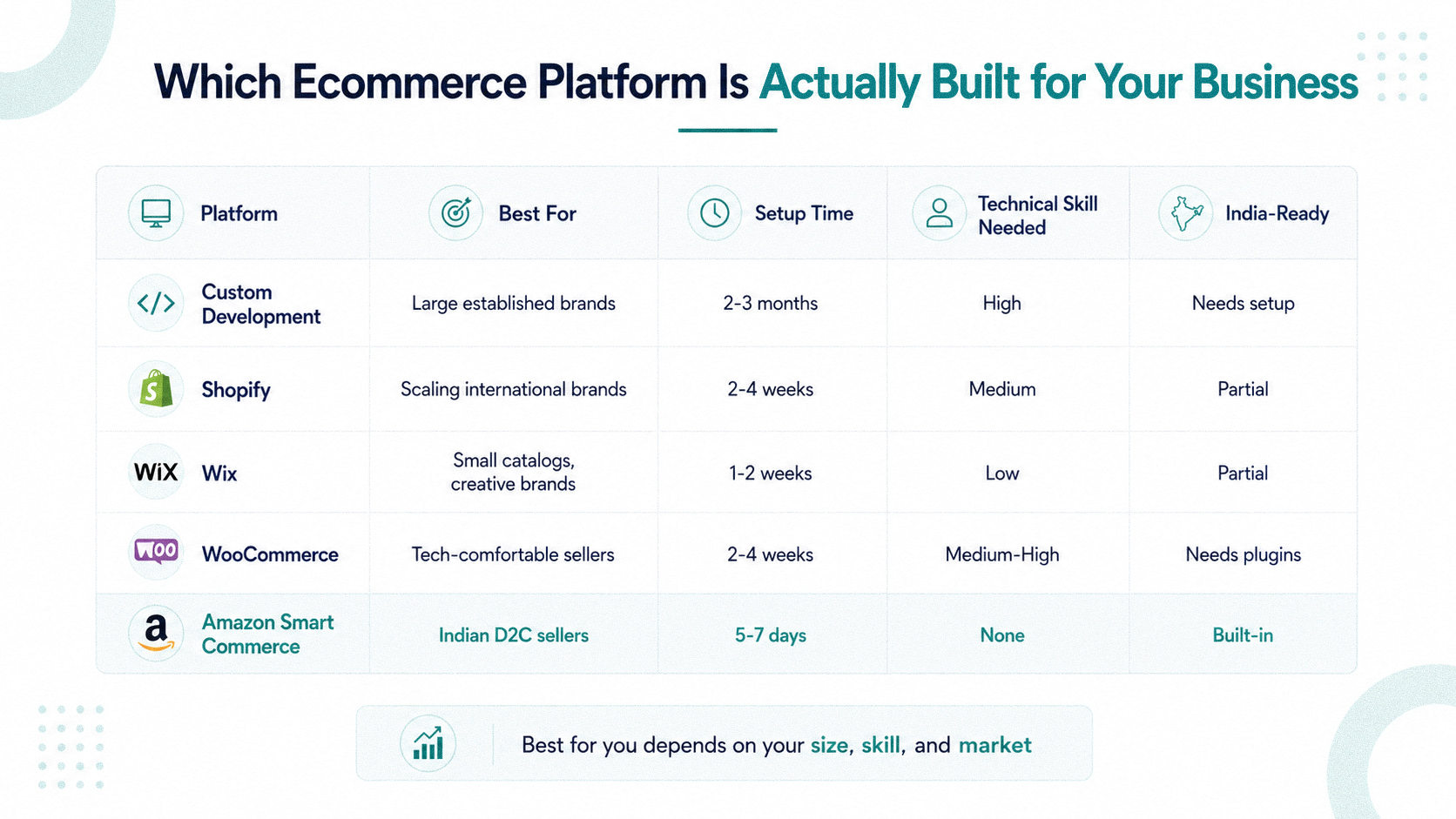
Custom development gives maximum flexibility and a completely unique storefront. It's the right choice for established brands with complex requirements, dedicated developer budgets, and timelines that allow 2-3 months before launch. It's the wrong choice for sellers who need to start generating revenue quickly.
Shopify is one of the most widely used international ecommerce platform options. It handles large catalogs well, has a strong app ecosystem, and scales effectively. Indian sellers need to verify payment gateway compatibility and factor in transaction fees that apply on certain plans, along with app costs for India-specific features.
Wix suits smaller catalogs and creative businesses that prioritize design flexibility. It works well for sellers with 20-50 products but can become limiting as catalogs and order volumes grow beyond a certain point.
WooCommerce (built on WordPress) offers significant flexibility for sellers comfortable with technical setup. It requires separate website hosting, theme selection, and plugin management, which adds both cost and ongoing complexity.
Amazon Smart Commerce is built specifically for Indian D2C sellers and is trusted by 10,000+ brands. Setup takes 5-7 days with no coding required, and the platform reduces total running costs by up to 44% compared to other platforms. What makes it different is how much comes built in: payments, logistics, WhatsApp marketing, Meta and Google ad integrations, coupon tools, and an RTO Reduction Suite that cuts return losses using Amazon's own address quality data.
The Buy with Amazon integration brings Amazon's checkout experience and customer reviews directly to your storefront, which helps improve conversions significantly. Themes are SEO-optimized, load in under 2 seconds, and are designed to convert from day one. For sellers who want to create an ecommerce website without juggling multiple subscriptions, this is the most straightforward option available in India.
Custom development gives maximum flexibility and a completely unique storefront. It's the right choice for established brands with complex requirements, dedicated developer budgets, and timelines that allow 2-3 months before launch. It's the wrong choice for sellers who need to start generating revenue quickly.
Shopify is one of the most widely used international ecommerce platform options. It handles large catalogs well, has a strong app ecosystem, and scales effectively. Indian sellers need to verify payment gateway compatibility and factor in transaction fees that apply on certain plans, along with app costs for India-specific features.
Wix suits smaller catalogs and creative businesses that prioritize design flexibility. It works well for sellers with 20-50 products but can become limiting as catalogs and order volumes grow beyond a certain point.
WooCommerce (built on WordPress) offers significant flexibility for sellers comfortable with technical setup. It requires separate website hosting, theme selection, and plugin management, which adds both cost and ongoing complexity.
Amazon Smart Commerce is built specifically for Indian D2C sellers and is trusted by 10,000+ brands. Setup takes 5-7 days with no coding required, and the platform reduces total running costs by up to 44% compared to other platforms. What makes it different is how much comes built in: payments, logistics, WhatsApp marketing, Meta and Google ad integrations, coupon tools, and an RTO Reduction Suite that cuts return losses using Amazon's own address quality data.
The Buy with Amazon integration brings Amazon's checkout experience and customer reviews directly to your storefront, which helps improve conversions significantly. Themes are SEO-optimized, load in under 2 seconds, and are designed to convert from day one. For sellers who want to create an ecommerce website without juggling multiple subscriptions, this is the most straightforward option available in India.
India-Specific Features Every Ecommerce Website Builder Should Offer
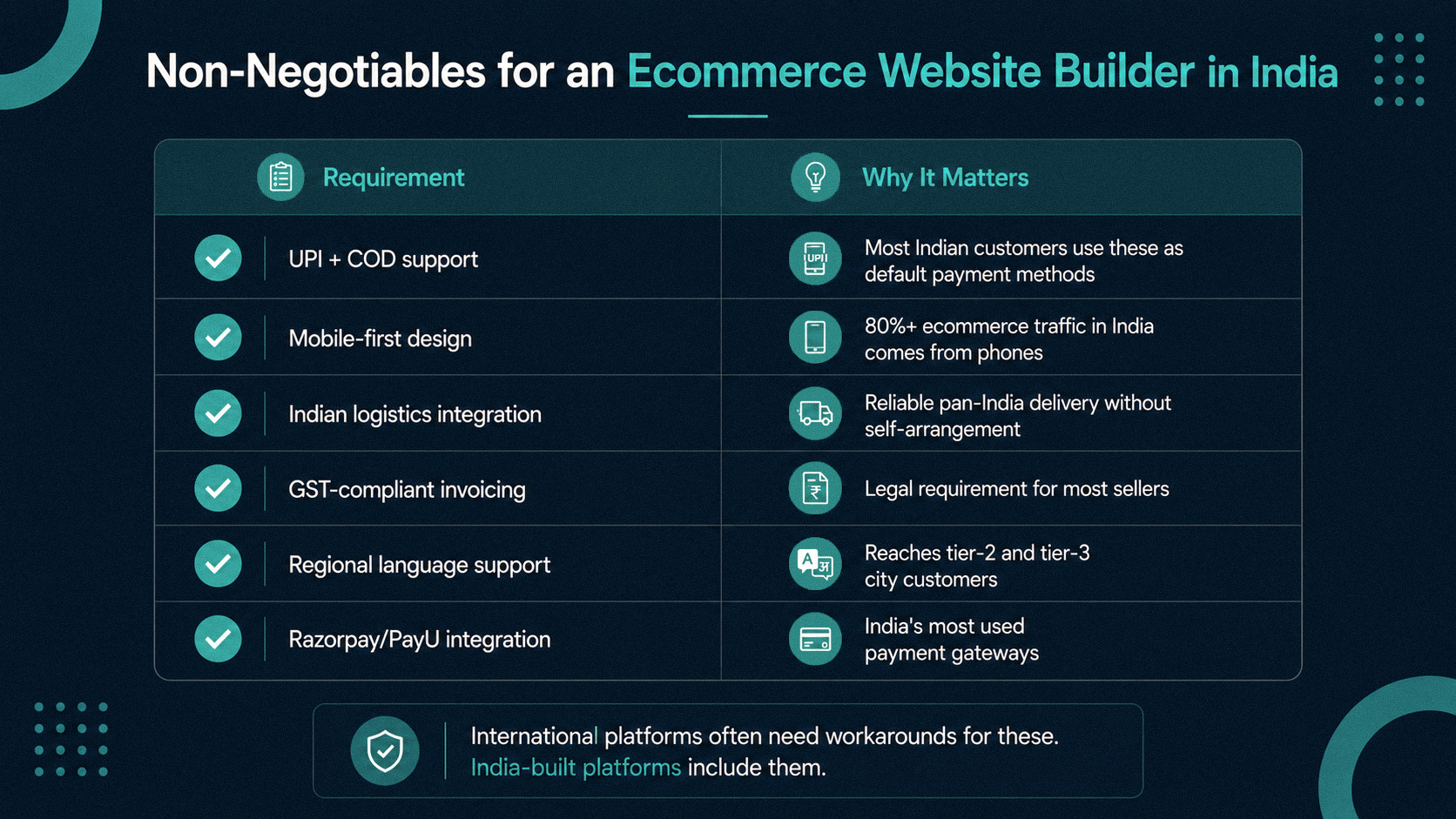
Choosing an ecommerce website builder India context means evaluating platforms against requirements that international comparisons frequently don't cover.
UPI and COD support are the payment methods a significant portion of Indian customers use as their default. Any platform requiring plugins or workarounds to support these creates friction that directly affects how many visitors complete a purchase.
Mobile-first responsive website design means the mobile experience is the primary design consideration, not an afterthought. Test any platform you're evaluating on an actual mobile device before committing, not just a desktop browser.
Indian logistics integration with reliable courier partners and last-mile delivery across tier-2 and tier-3 cities matters enormously for sellers targeting pan-India customers. Platforms with pre-built logistics partnerships eliminate the need to negotiate rates and manage courier relationships independently.
GST-compliant invoicing is a legal requirement for most ecommerce sellers. Verify that invoice generation on any platform produces GST-compliant documents without requiring additional plugins or custom development.
Regional language support expands reach into markets where customers prefer browsing and buying in Hindi, Tamil, Bengali, or other regional languages, which represents a significant opportunity that English-only storefronts miss entirely.
Customer segmentation and marketing tools built into the platform let you group customers by behavior, purchase history, and engagement levels without exporting data to a separate CRM. In the Indian D2C context, where WhatsApp and email retargeting drive significant repeat revenue, having segmentation available natively means you can target abandoned cart customers, one-time buyers, and loyal repeat customers with the right message without setting up additional tools.
Catalog sync across channels ensures that when you update a product price, description, or stock level in one place, it reflects everywhere automatically. Without this, sellers managing their own website alongside marketplace listings end up with pricing inconsistencies, overselling out-of-stock products, and hours of manual updates after every inventory change.
UPI and COD support are the payment methods a significant portion of Indian customers use as their default. Any platform requiring plugins or workarounds to support these creates friction that directly affects how many visitors complete a purchase.
Mobile-first responsive website design means the mobile experience is the primary design consideration, not an afterthought. Test any platform you're evaluating on an actual mobile device before committing, not just a desktop browser.
Indian logistics integration with reliable courier partners and last-mile delivery across tier-2 and tier-3 cities matters enormously for sellers targeting pan-India customers. Platforms with pre-built logistics partnerships eliminate the need to negotiate rates and manage courier relationships independently.
GST-compliant invoicing is a legal requirement for most ecommerce sellers. Verify that invoice generation on any platform produces GST-compliant documents without requiring additional plugins or custom development.
Regional language support expands reach into markets where customers prefer browsing and buying in Hindi, Tamil, Bengali, or other regional languages, which represents a significant opportunity that English-only storefronts miss entirely.
Customer segmentation and marketing tools built into the platform let you group customers by behavior, purchase history, and engagement levels without exporting data to a separate CRM. In the Indian D2C context, where WhatsApp and email retargeting drive significant repeat revenue, having segmentation available natively means you can target abandoned cart customers, one-time buyers, and loyal repeat customers with the right message without setting up additional tools.
Catalog sync across channels ensures that when you update a product price, description, or stock level in one place, it reflects everywhere automatically. Without this, sellers managing their own website alongside marketplace listings end up with pricing inconsistencies, overselling out-of-stock products, and hours of manual updates after every inventory change.
AI-Powered Features That Matter in 2026
The gap between platforms with and without AI powered ecommerce capabilities has widened significantly. These are now practical tools that change how quickly sellers build and maintain professional catalogs.
AI catalog generation creates product titles, descriptions, and attributes from product photos automatically. What previously took 2-4 hours per SKU now takes minutes, with consistent quality across the entire product catalog. Amazon Smart Commerce's Catalog Agent handles this natively without requiring a separate subscription.
AI image enhancement transforms basic phone photos into professional lifestyle images. For sellers without photoshoot budgets, this closes the quality gap between small brands and established competitors significantly.
Automated customer segmentation in the analytics dashboard identifies which customers are most likely to buy again, which are at risk of churning, and which segments respond to different offer types, without requiring manual data analysis. These insights feed directly into more effective marketing and retargeting.
Website builder tools with AI assistance now generate page layouts, suggest product arrangements, and optimize content for search visibility automatically. Features that previously required specialist knowledge are now accessible to sellers without technical backgrounds.
AI catalog generation creates product titles, descriptions, and attributes from product photos automatically. What previously took 2-4 hours per SKU now takes minutes, with consistent quality across the entire product catalog. Amazon Smart Commerce's Catalog Agent handles this natively without requiring a separate subscription.
AI image enhancement transforms basic phone photos into professional lifestyle images. For sellers without photoshoot budgets, this closes the quality gap between small brands and established competitors significantly.
Automated customer segmentation in the analytics dashboard identifies which customers are most likely to buy again, which are at risk of churning, and which segments respond to different offer types, without requiring manual data analysis. These insights feed directly into more effective marketing and retargeting.
Website builder tools with AI assistance now generate page layouts, suggest product arrangements, and optimize content for search visibility automatically. Features that previously required specialist knowledge are now accessible to sellers without technical backgrounds.
Ecommerce Website Launch Checklist
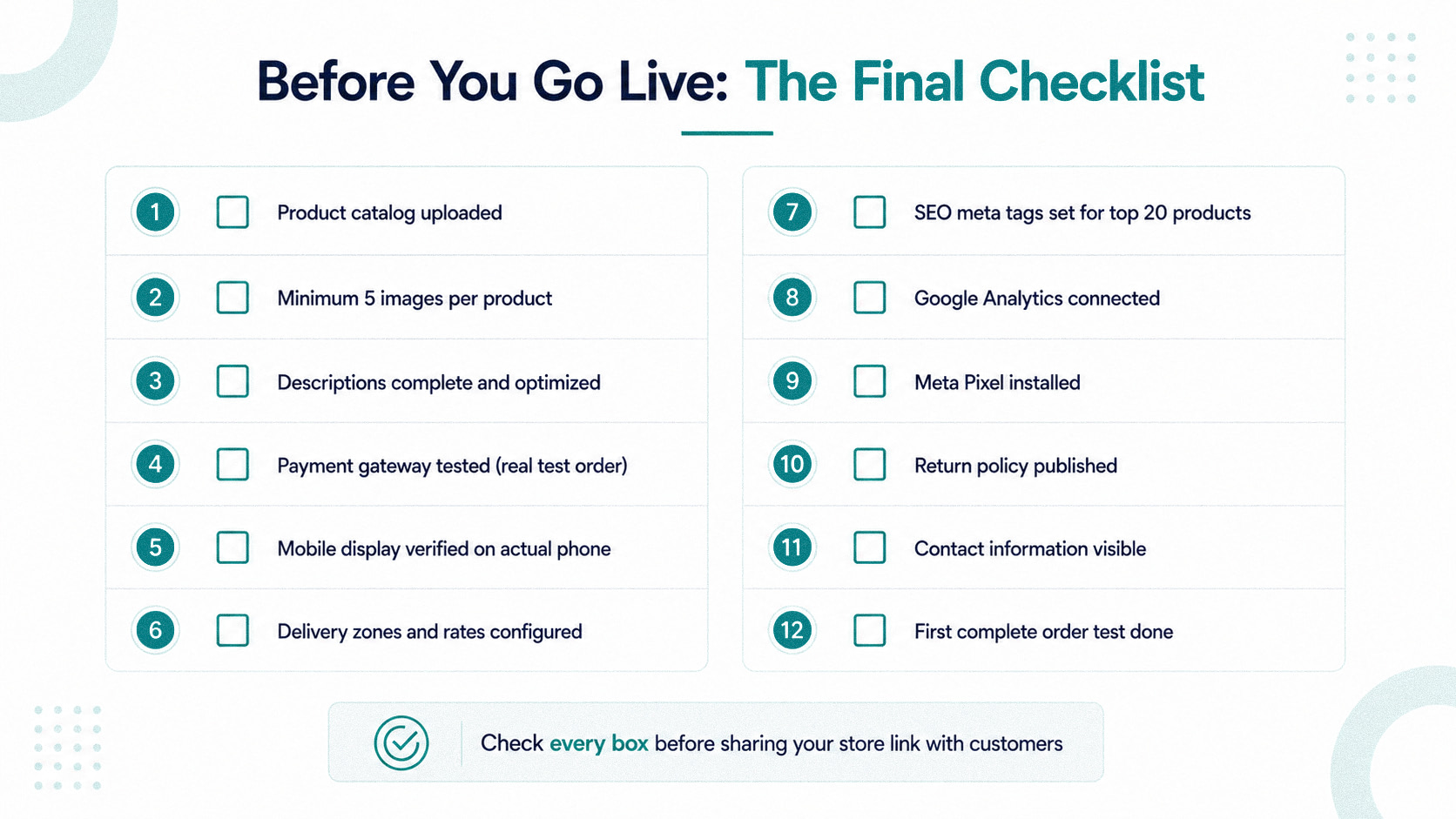
Before sharing your online store with customers, make sure you've completed these essential steps:
• Upload your product catalog with optimized titles, descriptions, pricing, and at least five high-quality images.
• Choose a brand-aligned theme that reflects your business and offers a seamless shopping experience.
• Test your checkout flow by placing a complete order on both desktop and mobile.
• Configure shipping settings including delivery zones, shipping charges, and timelines.
• Optimize for SEO by adding meta titles, descriptions, and relevant keywords to key product pages.
• Connect your social channels like Instagram, Facebook, and WhatsApp to drive traffic to your store.
• Install Google Analytics and Meta Pixel before launching to track visitors and conversions.
• Verify your complete order journey, from purchase to delivery confirmation.
• Publish essential policies including Return & Refund, Shipping, and Contact Us pages.
• Review your website on mobile to ensure fast loading, easy navigation, and a smooth shopping experience.
• Choose a brand-aligned theme that reflects your business and offers a seamless shopping experience.
• Test your checkout flow by placing a complete order on both desktop and mobile.
• Configure shipping settings including delivery zones, shipping charges, and timelines.
• Optimize for SEO by adding meta titles, descriptions, and relevant keywords to key product pages.
• Connect your social channels like Instagram, Facebook, and WhatsApp to drive traffic to your store.
• Install Google Analytics and Meta Pixel before launching to track visitors and conversions.
• Verify your complete order journey, from purchase to delivery confirmation.
• Publish essential policies including Return & Refund, Shipping, and Contact Us pages.
• Review your website on mobile to ensure fast loading, easy navigation, and a smooth shopping experience.
Pro Tip: One of the most common launch mistakes is sharing your website before testing the complete purchase journey. A broken checkout, missing payment option, or incorrect shipping setup can cost you customers before your business even gets started. Spending 30 minutes on this checklist can save hours of troubleshooting later.
Choose the Right Platform. Then Focus on Growing Your Business.
The best ecommerce website builder isn't necessarily the one with the longest feature list -it's the one that helps you launch quickly, manage your business efficiently, and grow without unnecessary complexity or costs.
In 2026, starting an ecommerce website no longer requires months of development or deep technical expertise. The right platform should handle the technology, so you can spend your time on what matters most: building your brand, serving customers, and increasing sales.
In 2026, starting an ecommerce website no longer requires months of development or deep technical expertise. The right platform should handle the technology, so you can spend your time on what matters most: building your brand, serving customers, and increasing sales.
What to Look for in an Ecommerce Website Builder
When evaluating platforms, prioritize one that helps you:
• Launch your online store quickly.
• Manage products, orders, inventory, and payments from one place.
• Scale your business without relying on developers.
• Access built-in tools for marketing, analytics, and growth.
• Keep your total cost of ownership predictable as your business grows.
• Launch your online store quickly.
• Manage products, orders, inventory, and payments from one place.
• Scale your business without relying on developers.
• Access built-in tools for marketing, analytics, and growth.
• Keep your total cost of ownership predictable as your business grows.
Build Your Store with Amazon Smart Commerce
Built specifically for Indian D2C businesses, Amazon Smart Commerce helps you launch your online store quickly without the complexity of managing multiple tools and subscriptions.
Here's what you get:
• Launch your ecommerce website in 5-7 days with no coding required.
• Accept payments and manage orders, inventory, and logistics from one platform.
• Grow faster with built-in WhatsApp marketing, Meta and Google Ads integrations, and coupon management tools.
• Minimize return losses with the RTO Reduction Suite, powered by Amazon's address quality intelligence.
• Increase buyer confidence with Buy with Amazon, bringing Amazon's trusted checkout experience and customer reviews to your website.
• Launch with SEO-optimized themes that load in under 2 seconds and are designed to drive conversions.
Instead of stitching together multiple apps for payments, marketing, logistics, and store management, Amazon Smart Commerce brings everything together in one platform - so you can spend less time managing technology and more time growing your business.
Here's what you get:
• Launch your ecommerce website in 5-7 days with no coding required.
• Accept payments and manage orders, inventory, and logistics from one platform.
• Grow faster with built-in WhatsApp marketing, Meta and Google Ads integrations, and coupon management tools.
• Minimize return losses with the RTO Reduction Suite, powered by Amazon's address quality intelligence.
• Increase buyer confidence with Buy with Amazon, bringing Amazon's trusted checkout experience and customer reviews to your website.
• Launch with SEO-optimized themes that load in under 2 seconds and are designed to drive conversions.
Instead of stitching together multiple apps for payments, marketing, logistics, and store management, Amazon Smart Commerce brings everything together in one platform - so you can spend less time managing technology and more time growing your business.


COMPANY


Built in

© 2026 Amazon.com, Inc. or its affiliates. All rights reserved